Monday, June 05, 2006

Castelos

Ontem eu fui "Castle Hopping" - passear de castelo a castelo. Eu fui com a Ruth e a Alison, duas "undergraduates" (universitárias) novas. Elas estão aqui em Gran Sasso fazendo "estágio" com o experimento XENON, e devem ficar uns 2 meses.
Nós pegamos o meu carro logo depois do almoço e fomos procurar pelo Castel del Monte. Eu já tinha visto placas dizendo a direção do Castelo semana passada, quando passiei de carro pela serra com o Peter, mas ainda não tinha chegado ao Castelo. Pegamos o mesmo caminho que fiz na semana passada, e a Ruth e Alison adoraram o passeio - os campos, os morros, as montanhas. E pra nossa surpresa, as montanhas mais proximas estavam todas cobertas de neve! Esfriou aqui em Paganica nos últimos dois dias, mas pelo visto esfriou muito mais na serra, e o bastante pra cobrir as montanhas completamente de neve. Mais longe daqui (e mais perto do Castelo), a neve acabou, e chegamos a uma região com muitas florestas. Finalmente chegamos ao Castel del Monte, num morro na subida de uma montanha. Na verdade, era um castelo antigo que foi convertido em várias casas (estilo apartamentos) e igrejas - já não parecia mais um castelo.
De lá fomos pra Rocca Calascio, que era um castelo medieval mais "típico". Ficava no topo de uma montanha, com torres e ponte levadiça. Foi o mais bonito (e com a vista mais bonita) do dia.
Depois fomos ao Castelvecchio, que era mais uma cidade fortificada, com um centro histórico de ruas muito estreitas e casas uma por cima da outra. Também foi bem legal, apesar de não ser um castelo mesmo.
Finalmente fomos a Prata d'Ansidonia. No caminho vimos umas ruínas romanas, mas eram só uns restos de paredes, nada muito interessante. Subindo um morro, chegamos ao castelo, que parecia fechado para turismo, apesar de ter sido reformado recentemente (5 anos) para ser usado como um teatro. Mas agora estava abandonado e decaído, não demoramos nada por lá.
Com isso encerramos o dia e voltamos pra Paganica, terminando o dia com Pizza e cerveja.

Edit: Added some pictures from Alison's camera (2006-06-13)
Para ver as fotos, clique aqui ou na foto acima. Posted by Picasa

Tuesday, May 30, 2006

Praia e Serra

Este fim-de-semana fiz bastante.
No Sábado, fui a praia com Simon (Post-doc francês) e a Ruth (undergrad nova, da Yale). Nós fomos uma praia no mar Adriático, na costa leste da Itália. De acordo com a Maria Elena (Post-doc Italiana), era pra ser ha uns 40 minutos de distância. Mas com o trânsito no litoral, demorou mais uns 40 minutos pra irmos da estrada pra praia mesmo. A primeira parada foi em Roseto, que foi uma decepção: a praia era de pedras (seixos), não muito confortável. O Simon e a Ruth, que pelo visto não entendem muito de praia, queriam ficar, mas eu insisti que a gente andasse a procura de uma pra de verdade (isto é, com areia). Finalmente achamos a praia de Pineto, mais ao sul, que era praia de verdade. Tinha areia, bares com mesinha, só faltou ondas. Não se pode ter tudo (pelo menos não aqui na Itália...).
No domingo saí com o Peter a passear de carro pela serra. Finalmente exploramos a região, indo de uma ponta a outra. Primeiro fomos para o oeste, onde achamos um lago bonito na montanha (o Lago Campotosto), com vista espetacular. A água estava congelando. Como ainda há bastante neve nas montanha, e a água do lago deve ser do degelo da primavera, o frio era esperado. De lá fomos para o leste, onde demos a volta no pico principal (o Corno Grande), e subimos para o Campo Imperatore, uma estação de esqui, que fica ao pé da montanha. Infelizmente estava começando a ficar nublado, e mais uma vez não consegui ver o Corno Grande de frente (ainda não consegui vê-lo desde que cheguei aqui!).
Clique aqui ou na foto acima para ver o álbum de fotos.
Posted by Picasa

Sunday, May 07, 2006

Subindo a Serra

 
Rick (meu orientador / professor) acabou de voltar pra Itália na sexta-feira a noite. Pro meu espanto, ele resolveu ir com a gente (eu mais dois estudantes de doutorado, Angel e Eric) pra subir uma das montanhas de Gran Sasso. Primeiro paramos pra almoçar Pizza no caminho, onde entramos na "conversa" com os locais (nosso Italiano ainda é bem rudimentar) e acabamos sendo convidados pra jantar na casa de um deles esta semana, pra ele "praticar o inglês".

Esta é a segunda vez que eu e Angel tentamos subir a serra. Desta vez não fomos a montanha principal, mas a uma outra montanha mais baixa, menos rochosa, que o Rick tinha visto quando ele veio pela primeira vez com a esposa e achoo o cenário bonito.

Edit (2006-05-28): O nome da montanha que subimos é Monte Cristo.

A subida durou umas duas horas, e foi um pouco difícil no topo por causa do vento e do frio. Estava com as mãos congelando, mas a culpa foi minha, porque eu ficava com elas expostas de tando tirar fotos.

Clique aqui ou na foto acima para ver o álbum de fotos. Posted by Picasa

Monday, April 24, 2006

Fim de Semana

Finalmente um fim-de-semana relaxado - um fim-de-semana de verdade! Tive que trabalhar um pouco, e tive um "plantão" no domingo a noite até segunda de manhã, e por isso resolvi não viajar, ficar em Paganica (onde estou morando) mesmo e descansar, que dias como estes são raros.

No Sábado passei a manhã em casa lendo, e boa parte da tarde almoçando. Não que eu tenha comido muito, mas foi um almoço demorado e long. Eu estava indo comprar uma pizza para um almoço rápido, quando encontrei um pessoal do experimento XENON e saímos pra almoçar juntos. Fomos a este restaurante no campo, um pouco fora da cidade, que o Alfredo (que é de Paganica) recomendou. O lugar é bonito, entre dois riozinhos, com muita árvores, bem rústico. Como o Alfredo conhecia os donos, trataram a gente super-bem. Nem menu trouxeram: o dono veio e disse que ele ia escolher e preparar o nosso almoço. A entrada foi um prato de presunto defumado, queijo, torrada com patê. O "primo" (o primeiro prato - massa) foi gnocchi e fettucine, e o "secondo" (o prato principal, a carne) foi lingüiça, carneiro e porco na brasa. A comida foi cara, mas valeu apena. Já vi que vou ter que desistir de gastar pouco se eu quiser comer bem aqui na Itália. Quando cheguei em casa já eram umas 4:30. De lá eu fui pra praça com meu laptop pra comer sorvete e começar a escrever isto. É muito legal, eu na Itália, sentado numa "gelateria", comendo sorvete, escrevendo no meu laptop e admirando a paisagem de montanhas cobertas de neve. Vida boa...

No Domingo resolvi subir uma das montanhas. Chamei o Angel e fomos pra Funivia, de onde começam as trilhas de motanhismo. Gran Sasso é uma serra, e sua strutura principal é um planalto com algumas motanhas em cima, e o pico mais alto destas montanhas é o Corno Grande, com quase 3km de altura. A área de motanhismo fica logo atrás do lab. Nós subimos boa parte do planalto (1km na vertical), mas não chegamos ao topo, porque o caminho estava bloqueado com neve. Talvez desse pra contornar os campos com neve, mas isso devia demorar e a gente não tinha comida, água ou tempo suficiente. Nós tínhamos começado tarde, e eu tinha que trabalhar de noite, e decidimos tentar outra vez quando a neve já tivesse deterretido.

Ah, e quase que ia me esquecendo: no caminho de volta, Angel pisou numa cobra! Eu vinha atrás dele, e de repente vejo algo se movendo e fazendo barulho de onde ele tinha acabado de pisar. Era uma cobra, me encarando e fazendo aquele barulho que as cobras fazem (silvo?). Eu chego mais perto pra tirar foto mas ela resolve fugir antes que eu pegue ela com um galho de árvore. Foi legal.

Clique aqui ou na foto acima para ver o álbum de fotos. Posted by Picasa

Monday, April 17, 2006

Ines, a doida

 Esta é a Ines, a doida portuguesa. A gente estava conversando na internet, e ela me diz já tem algumas fotos da viagem pra Veneza (que ela fez logo depois da viagem a Florença). Eu peço pra ela me mostrar algumas, e ela diz que tem uma foto que ela tirou só pra mim, e me manda uma foto. Quando eu abro o arquivo, está esta foto! Posted by Picasa

Roma, Parte Due

Finalmente tivemos um Fim-de-Semana de verdade, sem trabalho nenhum. O experimento teve um problema na Quinta-Feira, e depois dos PostDocs implorarem bastante, a Elena "permitiu" que a gente tivesse o Sábado e Domingo de "folga" (Segunda-Feira é feriado aqui na Itália, mas logicamente isso não conta para o experimento XENON).
Eu, Angel, e Simon (o Francês, PostDoc novo da Brown) fomos a Roma. A nossa primeira parada foi a Capela Sistina, mas não pudemos entrar porque havia uma fila de 1km para a entrada - e eu não estou exagerando! A fila começa na porta para o Museu do Vaticano, que fica numa ponta do Vaticano, dá a volta nas muralhas do Vaticano, e vai até a entrada lateral da Piazza di San Pietro, que fica na outra ponta do Vaticano. Era enorme! Quando alcançamos o fim da fila, vimos que já estávamos praticamente na Piazza di San Pietro, e então fomos pra lá. Havia também uma fila enorme para entrar na Basílica (dava uma volta completa na Piazza, dobrava e dava mais 1/4 de volta). Felizmente eu e o Angel já tinhamos visto a Basílica da outra vez, então não perdemos nada.
De lá fomos para o Castello Sant'Angelo, e sumbimos para o topo da torre principal, onde haviam vistas lindíssimas da cidade.
Subimos para a Piazza del Popolo, que era muito bonita, especialmente uma das fontes que foi feita em vários andares e subia um morro. Vimos lá a Chiesa di Santa Maria del Popolo, que tinha pinturas do Caravaggio e esculturas (e pirâmides!) do Bernini. Gostei bastante das esculturas de anjos sentados en arcos no teto da igreja, ficou um efeito legal.
Depois fomos a Vila Borghese, um parque com muitos jardins, fontes, esculturas, e museus. Como o dia estava muito bonito, com céu azul e muito quente, foi um passeio bom. Infelizmente, foi um passeio muito longo, e quando chegamos no Museu Borghese (no outro fim do parque), eles já não tinham mais ingressos. Também ficou muito tarde para irmos ao Fórum Romano (o Centro Antigo da cidade, cheio de ruínas romanas), que eu só tinha visto por fora da última vez e queria muito entrar desta vez. Fica pra próxima.
Ficamos a passear pelo Cento Histórico, passamos pela fonte de Trevi, onde esperamos as luzes se acenderem no fim da tarde, passamos pela Piazza di Spagna (onde as pessoas vão para "verem e serem vistas"), que estava lotada de gente, e finalmente no Colesseo, já no escuro (a iluminação era bonita).
Desta vez a comida foi um pouco melhor do que a última viagem a Roma. Em vez de irmos a restaurantes aleatoriamente, sentamos e procuramos no guia um lugar que parecesse bom pra comer. O almoço foi no Difronte, onde eu comi um raviolli que estava mais ou menos e muito pequeno (apesar do guia ter dito que as porções eram grandes). De noite jantamos no "La Base" (não lembro bem o nome, estava no guia do Simon), um "Diner" estilo americano, mas com pizzas e massa bem Romanas. As pizzas estavam muito boas, e bem baratas também (uma raridade em Roma). Ah, e quase que ia me esquecendo: comi bastante sorvete também, que aliás estava muito bom (mas não tanto quanto o de Florença) - até agora, a melhor comida da Itália.

Para ver as fotos, clique aqui ou na foto acima. Posted by Picasa

Monday, April 10, 2006

Florença, com Ines

Semana passada prepararam a rotação de "plantões" no lab, e vi que eu não ia ter um fim-de-semana - tinha plantão de Sexta a noite ao Sabado de manhã, e no Domingo o dia inteiro. Então quando percebi que pelo menos ia ter a Sexta de dia de folga, fugi na quinta a noite e fui me encontrar com a Ines em Florença, que tinha ido pra lá passear depois de terminar um "Congresso" de Teoria de Cordas em Trieste (no norte da Itália).

Não foi uma coisa muito bem planejada, foram 3 horas dirigindo (no carro que compartilho com o grupo da Brown) de Gran Sasso pra Florença, mais 1 hora pra achar o hotel - a cidade é super complicada, e cheia de ruas de mão única, sempre na direção conrária! Pelo menos deu pra ver algumas ruínas romanas enquanto estava perdido. Finalmente cheguei lá, e logo de entrada já fui vendo como a cidade é bonita, com as pontes antigas, muitos casarões, muitas praças, de arquitetura muito bonita. Não tem a abundancia de estátuas e arte em geral que Roma tem, mas ainda sim é belíssima. No dia sequinte andamos bastante pela cidade. Primeiro fomos a biblioteca dos Medici, onde acabei pisando numa obra do Michelangelo (era uma escada). Vimos o Duomo, a Catedral principal da cidade, com uma cúpula gigantesca, e com a façada de mármore muito colorida e cheia de estátuas. Depois fomos a Piazza della Signoria, o centro histórico/político da cidade, onde ficam o palácio do governo e vários prédios da burocracia local, inclusive um prédio de escritórios dos Medici, a família que controlava a cidade durante a Renascença e que patrocinou o Michelangelo. Na Piazza fomos ao museu do Ufizi (o antigo escritório dos Medici), que tem a maior concentração de arte da Itália. Quando ele foi construído, os Medici reservaram o segundo andar exclusivamente para colocar obras de arte, para servir de inspiração ao trabalho. No museu havia vimos quadros de da Vinci, Michelangelo, Rafael, e outros. Na Piazza vimos várias estátuas famosas, entre elas o David de Michelangelo. Quer dizer, vimos as cópias, porque as originais foram levadas para dentro de museus, para protegê-las do tempo e de pessoas. Aliás, o mesmo aconteceu com várias das estátuas na cidade, como as do Duomo.

A comida, tanto o almoço quanto jantar, não foi nada boa, mas pelo menos comemos um sorvete que estava uma delícia (melhor coisa que já comi aqui na Itália, ams infelizmente não lembro o nome), e que comemos na Piazza della Signoria enquanto admirávamos as esculturas. Passamos o resto do dia a ver a cidade, igrejas, e o Palazzo Vecchio (mas só o lobby, a entrada era muito cara). Eu tinha uma conferência por telefone para participar as 6 da tarde, e devia ter voltado para Gran Sasso, mas o Peter (estudante da Brown, a gente divide o apartamento em Paganica) me deu a idéia de ligar via Skype. Então eu achei um Internet Café, liguei meu laptop e Webcam, e participei da conferência de Florença. Ninguém soube! Acabamos o dia indo ver o pôr-do-sol na Piazzale Michelangelo, que tinha uma vista espetacular da cidade, e principalmente do Duomo, muito maior que os outro prédios da cidade. Depois fui deixar a Ines na estação de trem, porque ela ia para Veneza passar dois dias e pegar o avião de volta para os EUA. Eu voltei para Gran Sasso, depois de mais uma hora perdido em Florença.

Clique aqui ou na foto acima para ver o Álbum de Fotos Posted by Picasa

Sunday, April 02, 2006

Roma

The experiment had some problems on Wednesday, and we had to stop it to fix it. Normally that would be good news, because it would take a couple of days to fix it and we wouldn't be able to start until Friday or Saturday, guaranteing the free weekend. Normally, but not in the XENON experiment. In this experiment, it meant we would start on Saturday, and continue working through the weekend. After all, why wouldn't we want to work on the weekend? This was Elena's (the PI from Columbia, and spokeswoman of the Experiment) thinking, and ultimately her decision, taken arbitrarily and without consultation, to everyone else's dismay. Naturally everyone was upset, specially the the grad students that did not work directly for her (like me), as we are not yet used to the complete lack of reasonableness. Fortunately for us, unfortunately for them, her Post-Docs came to a solution: all Post-Docs would work through the weekend, while the grad students would be allowed not to work this weekend (mind you, we had already worked through last weekend). Thus we were freed at last, and hasted into getting the hell out of town before anyone changed their minds. And we made our way into Rome.

I joined with 3 other grad students, Luis (from Coimbra, Portugal), Angel (Mexican, from Yale) and Roman (Texan, from Rice U.) and by bus we reached Rome at 10:30. We headed straight to the Vatican, where we were amazed by the beauty of the huge St. Peter's square and disappointed by the even larger line to enter St. Peter's Basilica. Regardless, we braved it and entered the basilica. It is an enourmous building, and the domes, although famously large, is just a detail in the gigantic structure. Everything is covered in details, paintings, statues. I am no fan of sculpture as an art form, but I was impressed by the amount of work put into the decorations and statues. I was specially impressed with the fluidity of marble "fabric", like the Bernini sculpture of women holding a red marble "mantle" that flowed from a underneath the statue of a pope and covered a flying skeleton (death), all built above and around a door close to the main tomb. Perhaps I would have been more impressed by Michelangelo's Pietà, housed close to the entrance, but it was a small statue and kept far from the public by a plastic wall, which made proper appreciation difficult. Also house in the Basilica were St. Peter's tomb and the body of a pope inside a transparent casket. I couldn't tell who the pope was because the place was devoid of labels and signs for tourists.

From the Basilica we tried to go to the Sistine Chapel, but it was closed (it has a strange and complicated schedule). We decided to leave it for the next time, like we did with going into the Castle of Sant'Angelo, next door to the Vatican. From the Vatican we headed into the Historic Downtown, and just walked around as much as we could. We visited the Piazza Navona, with its 3 fountains, the central one done by Bernini. We ate at a restaurant close to the Pantheon, Opera Cafe, where we ate the "tourist menu", a selection of appetizer, main dish and side dish, plus water and coffe. The food wasn't cheap (12 euros), didn't taste particularly good and came in small portions, so I wouldn't recommend. We visited the Pantheon, the collosal ancient temple of the ancient Gods, where Raphael is buried (on his tomb, the inscription: "Here lies Raphael, by whom the mother of all things [Nature] feared to be overcome whilst he was living, and whilst he was dying, herself to die"). We headed to the Fountain of Trevi, which beautifully blends an ancient temple look with natural-looking "rock formations". Then we headed to the Roman Forum and Coliseum, and we just ended the day walking around the ruins and parks of the Roman Forum and Circus Maximus, until sunset. Afterwards, we went to the Spanish Steps, which was full of young people who seemed to go there to see and be seen. There we rested a little, enjoying the view, and finally we left to the bus station.

Although I list here only a few places and sights, we saw a myriad of beautiful building, statues, fountains, bridges, sculptures and structures everywhere, but it's just so much to detail every single single of even to capture them all in pictures. At some point, you just realize there is too much to take pictures of everything and you decide you are wasting time snapping pictures instead of just enjoying the view. I know this doesn't help, but you really have to see it in person. There is more than just the individual objects that are catalogued in pictures - there are the streets, the views, the angles, the backgrounds, all the different compositions and effects that really require one to just walk around to take the city in. I don't think I have enough experience with cities like this, haven't visited [let's say] Paris, and having only New York, Lisbon and Porto as points of reference; but what strikes me most about it is the sheer volume of history and art all around the city. There is plenty of history and art in Lisbon and Porto (New York pales in comparason, so let's drop it), but not so explicitely and abundantly as I found in Rome. We walked fast through the city and its sights for an entire day, knowing full well that we would only get an "outline" of the city, that we would need several future trips to see it all, but I think we only managed to skim a fraction of its surface. We look at the maps and books and there is still so much more to see and experience...

I think what best prepared me for the experience was the novel "Angels and Demons", by Dan Brown. I especially liked recognizing all the places from the book. The book center on a Harvard professor running around Rome and its touristic attractions trying to stop a plot to destroy the Vatican, and it includes many of the places that I saw: the Pantheon, the Piazza Navona, the Castello Sant'Angelo, and many others. In spite of terrible physics elements it contains (I cringed at its use of anti-matter), it is still a thrilling and fun book, very similar to his other work, "The Da Vinci Code", and I highly recommend the book, specially if you are coming to Rome :)

Now, a note about the pictures. Naturally, I wanted pictures of me in front of the sights, and I asked Roman, and sometimes Luis, to take pictures of me in front of stuff. This was a mistake, because Roman screwed up almost every picture in some way or another. I would have been better off asking strangers to take the pictures. First, it seemed that his focus was on the person and not on the sight, which is pretty stupid because you can take pictures of people anywhere, even at home - the location, the scenery is what matters in trip pictures. You don't have to capture the whole person, from toes to head, a waist or breast to head shot would suffice. With few exceptions, nobody is interested in seeing feet and floors. In most cases, you can safely put the horizon line close to the bottom edge of the picture. Also, the person doesn't need to be at the center of the picture. In fact, it's probably best to put the person to the side (1/3 point), taking as litle space as possible, to try to get as much of the scene as you can. NEVER sacrifice the scene to get the person in! There were a couple of picture that were useless because they failed to actually show the interesting features of the sight, focusing solely at the person. For instance, there is one picture of me (not included in the Album) in front of a highly worked fountain with statues. But because of the way it's framed, you can't actually see it! I mean, you can see I am in front of something made of marble that probably has statues and probably has intricate work, but the person (me) covers the intricate work in the middle of the fountain and the statues, that are on either side, are cut out, so that you can only see part of a leg of one and the head and one arm of the other, completely missing the composition. And there are plenty of other pictures that cut out the bodies of obelisks, nice windows in the buildings, or that simply do not capture the scenery in a meaningful way, like te picture of me in front of the Pantheon, where you can see columns but not the temple (the picture I took of him was much better). Another thing that annoyed me is that the pictures weren't difficult to take - whenever I took the same picture (like of him in front of the Pantheon, not in Album), the angle and framing were much better! Finally, he was insistent on taking vertical pictures even when I asked him to take horizontal pictures, because these come out much better on the computer screen. Anyway, sorry for the rant, but I just went through the pictures and was very disappointed to see so many potentially good pictures of me in Rome wasted because of bad framing.

In spite of the complaints, there are tons of great pictures, and if you feel like seeing them, you can click here for the small album (31 photos) or here for the large one (77 photos). The picture above will take you to the small album.
Posted by Picasa

L'Aquila e Il Castello

The closest city to the village of Paganica, where I am living, is L'Aquila ("The Eagle"), with ~130,000 inhabitants. According to the guidebook Lonely Planet Italy, it's a grey, cold city, and it doesn't seem very recommendable. However, I have just found out that it can be very lively and warm, at least on Saturday nights, when the young people completely fill the streets of the historic downtown and there are huge crowds walking the streets and congregating in front of bars and nightclubs. I had just come back from Rome at 11pm (I will talk about that trip on a future post), and went to meet Peter (my colleague/roommate) and his girlfriend in L'Aquila downtown. There was some people on the streets, but not many, and Peter told me that they had come the day before (Friday night) and the place was pretty dead. We were all surprised when around midnight the place became so full it was hard to walk the streets.

Another nice surprise was the Castle. Built in 1532 atop a hill, on the edge of the historic downtown, the castle is a solid and imposing stone structure. It is very large, blocky, and surrounded by a huge moat that helped enhance it's solid block look. It seemed to have a single entrance, a tall stone bridge over the moat. It's the first time a have seen a castle like that, a fortress with an actual moat and bridge.

See pictures in the Italia Photo Album, by clicking either here or in the picture above.Posted by Picasa

Tuesday, March 28, 2006

Pasta, Caffè e Vino

The food so far has not been impressive. We eat lunch at the Lab cafeteria, which is pretty expensive (U$8 a day), and at night we usually have pasta at home. It's really difficult not having pasta at every meal here, especially since I haven't had the chance to go to a supermarket to shop. I am going to have to watch what I eat really hard.

Last Wednesday (second day in Italy), I had my first coffee! It was not as bad as expected, and I will certainly be trying it more often. The thing is, I don't drink coffee. I haven't even tasted it in years, because just the smell tells me I am not going to like it. But I had a cappucino at the Lab Cafe and it tasted all right. The second coffe I had, a machiado (coffee and milk) wasn't so good, though.

On Thursday we had dinner at Alfredo's parents house (he is an Italian post-doc). The meal was amazing. It was a six course meal - SIX COURSE! It had appetizers, cold cuts, soup, pasta, main dish (rabbit!), and dessert. Also plenty of wine, which I tried (I usually hate wine). I think my experience with this wine was opposite that of most people - I liked the first glass, but with each subsequent glass I liked it less and less, and by the 5th I thought it just tasted terrible. It was a really fun night, everybody from XENON here in Italy was there.

This weekend I had to work, and couldn't go to Rome. The first week here in Italy is over, and I still haven't seen Rome :(

The worse is that I didn't really have to work during the weekend, but Elena (Columbia's PI and the XENON Project leader) insisted that we get the work done in the weekend, even though everybody else was of the opnion that it could wait. Because of the way she has been pushing things, everybody is pretty stressed and unhappy, and looking forward to when she leaves today. We actually toasted to her departure on a dinner last weekend.

I am a bit mad at the fact that I didn't see Rome this weekend, and at the fact that a few people still took off and had their weekend, but I am more mad at myself for not simply hopping on a bus and going to see L'Aquila (the larger city of the region), even if for only a couple of hours before having to go in on Sunday. Today I went there with Peter to run some errands, and it looks nice enough, with old churches and squares. I have to keep reminding myself that I am here for 3 months, and I still have plenty of time to see the sights. Hopefully.

Although I have been stuck in the Lab and at Paganica (the village where I live), I can't complain too much. I am still living in a charming Italian village, with an amazing scenery. We are situated in a mountain range, and Paganica is close to the bottom of the valley, so we are surrounded by spetacular vistas. Even at the lab the view is great (click on the picture above to see more photos).

Another thing that has made the work more bearable is Roman, a Texan Grad student. He is incredibly funny and cracks dirty jokes non-stop while we are working. He is older than all other grads and postdocs, but has put us all to shame with his energy. He has even made Elena blush, and she usually swears like a trucker!
Posted by Picasa

Wednesday, March 22, 2006

Italia!

 I'm in Italy!

I arrived yesterday at Rome and went directly to the lab, without time to see the city. Just as well, since it was raining. The Gran Sasso lab is in a small village next to L'Aquila, the larger city of the region. From the airport to L'Aquila it is about one and a half hours. After we leave the Rome area, we drive through some very pretty scenery, with mountains, valleys, little villages perched on steep mountain walls or peaks, and the odd little castle here and there. The lab itself has a great background: the snow coverd peaks of the Grand Sasso mountain range, which is breathtaking at clear weather (it finally cleared at end of the day).

I am sharing an apartment with Peter (the oher grad student from Brown) and Rick (the boss) at the nearby village of Paganica ("town of Pagans", apparently). The apartment is spacious enough, although my room is pretty cramped, and it can't be much more than 2x3m. At least the view from my window is awesome! (See picture above)

I will write more about first impressions and details later, right now I don't have a decent Internet connection, neither at the apartment nor at the office. I haven't been assigned an IP address yet, and I am on a borrowed connection. Posted by Picasa

Monday, February 27, 2006

More Audiobooks: Arthur C. Clarke

Now I am listening to some short stories by Arthur C. Clarke, read by the author. I have never read anything by him before, and I am impressed! I usually don't like Science Fiction, because I think it is too contrived, specially the pseudo-scientific explanations on how future technology works, and the way some stories try to explain paranormal events with made-up science (think of the microorganisms inside people that generate the "Force" in "Star Wars: Episode I"). In Clarke's tales, at least so far, no attempt is made in either way: he doesn't make up explanations for technology and phenomena that he couldn't possible explain, nor does he attempt to frame paranormal events in made-up science, he prefers to leave them in the realm of mysticism. In fact, that's what I like the most so far in his short stories - there is a pervasive mystical aspect to them, be in the Tibetan Monks that try to rush the Apocalypse by using a computer to "calculate" all true names of God, or in the Super-Computer that creates a new Universe ("Let There Be Light!") while trying to calculate the answer to the Big Bang, just as our Universe dies "of entropy". So although science and mysticism are featured in his stories, they are kept separated, each playing its part in grand scheme of things.

Edit (March 1st, 2006) - I had previously attributed these stories to Isaac Asimov, due to some unexplained brain fart. Now I give credit to the correct author.

Wednesday, February 22, 2006

NYC

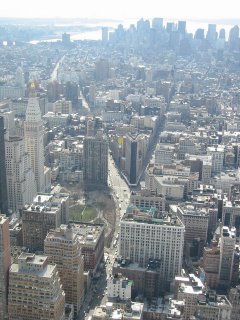
 Ines came to meet me here in New York and we went to spend the Saturday in the City. First stop was the Empire State building. The day was windy with perfectly clear skies, and afforded spectacular views of the City. Unfortunately, it also meant that it was extremely cold, specially up on the Empire State, so it was hard to just stand around and enjoy the views. But we managed. Afterwards, we went to see the skating ring at the Rockefeller Center, then had lunch on Chinatown at a little, very packed place called New Wonton (tip: don't get the soups with noodles, it's a waste when the wontons are so good). Later we went to the Met (Metropolitan Museum of Art), where we discovered, for the first time, reasonable prices for cultural attractions/events in the US - $10 for students. Plus, they are recommended fees, so if we wanted, we could have paid less (no, I paid full price!). We were in the Met only a little over one hour, and didn't see much. But I did see the Egyptian collection, which was cool, and the installation for the Temple of Dendur (see picture in Photo Album), which was awesome! They reconstructed this little Egyptian temple in a large, beautiful room, with Egyptian ornaments spread around in a sensible manner. It was very impressive. Posted by Picasa

Monday, February 20, 2006

Podcasts, Audiobooks and "Coraline"

After the recent discovery of GOOD podcasts, I have fallen in love all over again with my iPod. I had played with them before a few months back, right before Apple introduced them to its music store, but they were only mildly amusing and not worth the trouble. A few weeks back, though, I listened on my iPod to a lecture series on Poetry given by Jorge Luis Borges at Harvard, and it left me hungering for more. I wanted more philosophy, more literature, more history. It is hard these days to have the time to sit down and enjoy a good short story or magazine article. I used to devour them, but these days I only make time for headlines and short newspaper articles. No more philosophy, anthropology, archeology, or all these things that I also enjoy reading about. Thus I set out to find other audiobooks like the Borges lectures.

My first find was the Stanford iTunes sites, where I discovered the podcast of the "Philosophy Talk", the radio show that "questions everything, except your intelligence" (they are good with slogans - on their website: "cogito, ergo blog"). Although they are short and usually superficial, they have provided a good Philosophy fix for me. I later found the Nature podcast, produced by the journal, and with excellent content about all the other science - biology, geology, astronomy, even some anthropology and paleontology. It is definitely my favorite thus far. I will look for more like it when I have more time.

I am also having a good time listening to my Audiobooks, which have make the 3 hours commute to the Nevis Lab in NY a very pleasant trip.

I am currently "reading" Coraline (not a misspelling), by Neil Gaiman (the author of "American Gods" and "Sandman"), and it is a surprisingly good book. Surprising because its subtitle is "A Fairy Tale", and it seems to be children's book. The problem is, I still don't know if this is children's book or not. On one hand, the story is centered around the adventures of a little girl, and told in a manner that would appeal to little girls. This is specially effective in the audio version, because the author narrates the book as if he was reading a bedtime story to hildren, including silly names and funny noises. On the other hand, Neil Gaiman uses the exact same style present in his Sandman comics, a twisted yet easy plot, with obscure yet rich and vaguely familiar mythology, and a subtle horror or nightmare hidden in childish things. This is a very "Neil Gaiman" book, with a feel much closer to Sandman than American Gods. To me it shows the skill that Neil Gaiman has of creating stories that aren't simply about magical things, but told from a magical point of view - in this case, from a little girl's point of view.

But if you plan to start listening to Audiobooks, or would just like to read some Neil Gaiman, I highly recommend "Anansi Boys". It is the story of the sons of Anansi, an African God that emigrated to the United States, and that has just died. It is a very funny book, and a departure from the usual Neil Gaiman style. It reads a little like a Douglas Adams novel, although it is about magic and mythology rather than science fiction.

Sunday, February 12, 2006

Brownzilian's Carnaval, 2006

Last night was the Brownzilians' Carnival Party. It was early for Carnival (not until the end of February), but better early than never. The party was at the Graduate Student Lounge at Brown, organized by Daniel, Yeung and Sérgio (new Brownzilian, he is a Professor at Brown). There wasn't enough people to fill the room but there were definitely enough people for a fun party. Surprisingly, there were more Americans (at least non-Brazilians) than Brazilians. Strong Portuguese presence, most notably Catarina, a new Portuguese Grad student, with whom I danced since Ines was hiding in a conversation about String Theory and Portuguese Poetry most of the night.

The excellent music was provided by none other than me. I connected my laptop to the lounge's gigantic TV and stereo. I started and maximized iTunes, connected an external mouse and hid the laptop, so people couldn't spill beer on it. The idea was to have an interface to let people select songs during the party - you just used the mouse to select the song you wanted played next on the TV, and the music was routed to the stereo system, which was very loud. The whole system was pretty cool, too bad I didn't think of taking a picture of it. And needless to say, I had a great selection of songs to satisfy to everyone's tastes, from Samba to Salsa!

Click on the picture above or here for the pictures. (Pictures taken by Artur)Posted by Picasa

Thursday, February 09, 2006

Chinese New Year, 2006

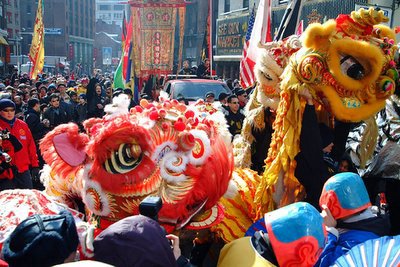
Ines and I went to Boston for Dim Sum this past Sunday, and we had a very pleasant surprise - apparently The Chinese New Year's celebration in Chinatown was this weekend!
We first saw that the streets in Chinatown were blocked, and littered with lettuce and vegetables (like what you see after some farmer's market). On the way to the restaurant saw several groups of people dressed in martial arts clothes, carrying weapons like swords and spears (I don't know if they were real), and flags. While eating, a group came in, and they had a Chinese Dragon that walked and danced between the tables. That's when we realized that this must be the Chinese New Year.
The best was when we left the restaurant, and were stopped by a group of people that started blocking the street with their staffs and opening a large circle. The a Couple of Chinese Dragons come in and start dancing, while some people play the drums in the back of small truck. After a little while, an "altar" made of boxes was set up in front of a grocery store, and the grocer brought out some fruit and lettuce, then a bucket with live lobsters, and another with live fish. The Dragons then made a show of accepting the "sacrifices" and eating them, to the intensifying sound of drums. The person at the head would stick out a hand and pick up the vegetables, smashing them and tossing them all over, and then pick up the lobster and fish and wave them as if the dragon was shaking them with their mouths. It was neat. But then the grocer started throwing fireworks, small clusters of little bombs, that would jump and blow up all over the place - this lasted some 5 min, and was not that neat. After watching this, we went to some Chinese stores, where we bought a ton of frozen Dim Sum and a sugar cane, which we just ate last night.
The whole day was pretty cool! Posted by Picasa

Thursday, January 12, 2006

Portugal, 2005 [English]

This is a little summary of my recent trip to Portugal with Ines. This should help English speakers understand the Portugal Photo Album. Note that it has ~50 pictures, and the legends are all in Portuguese. Click here for the larger album (>100 pictures).

To me the best thing about the trip was seeing all the Old World stuff: the Metropolis of the Portuguese empire, the medieval castles, the fortress-like churches, the Gothic monasteries, the entire country rich with old history.

The trip lasted about 3 weeks, and we visited the following places:

- Lisboa (Lisbon): The capital of Portugal. Ines has an apartment in the city, so we spent a lot of time there. The city is relatively new (as compared to the rest of the country), because an earthquake in 1755 destroyed the city and most of it had to be rebuilt afterwards (it is considered the "most disastrous" earthquake in history). The city was decorated for christmas, and that was very pretty, especially in the hiscoric downtown ("Baixa"). The city itself had its ups and downs: it was an even mix of a old buildings and streets (a couple of centuries old) with modern third-world buildings (the kind you see in any third-world large city these days). Lisbon is famed for its nightlive (featured recently on the NYTimes), but we only went out once while there (and it was cool, just like the Times said). One of my personal highlights of Lisbon is the district of Belém, where some impressive architeture is found in the "Torre de Belém" (a tower) and the "Mosteiro dos Jerônimos" (a monastery). These building are made in the Manueline style, from the 16th century, which is a evolution of the Gothic celebrating the Discoveries. Food Highlight: Rabbit (delicious, in the mall!) and fish (Tamboril - some ugly fish, don't ask). The food is otherwise average, leaning to homemade brazilian food, nothing spetacular.

- Setúbal: Portugal's third largest city, where Ines mother lives. The downtown was very pretty, narrow cobbled streets filled with nice old buildings which happened to house modern stores. It also had a couple of mediavel fortresses nearby: the Castle of Sao Filipe and the Palmela Castle, which were pretty cool. Setúbal is a fish city - people come all the way from Lisbon just to eat fish there. I thought the grilled fish was average (the Tamboril in Lisbon was much better), but I am told this is because it is not the right season.Food Highlight: Squid with Ink (the squid is fried with the ink! your mouth gets all black).

- Évora: where Ines's father lives, and where we spent Christmas Eve and New Year's. It is in the South, in the countryside. Évora is a town inside large, imposing medieval walls, while inside there is a labyrinth of narrow cobbled streets. There we also saw Diana's Temple (a Roman Temple) and the "Capela dos Ossos", a church of human bones and skulls. Nearby there are some pre-historic sites: a circle of stones, a dolmen, and more, all dating to about 5000-6000 B.C. Food highlight: the Meat Fondue at New Year's, with several sauces for dipping - really tasty! Also, the enormous variety of sweets at Christmas, although I only really liked the Farofias (egg whites cooked on milk, with sauce) that I made.

- Coimbra: Famous for its University, one of the oldest in Europe. We went to Cantanhede, a suburb of Coimbra, for Christmas Day with the family of Ines's mother. In the end, we didn't really have time to see Coimbra, we just had a peek at the University and at Downtown (seemed pretty, though). Food highlight: roasted piglet (not sure that's the right word). It is the specialty of the region - there is a long street lined with dozens of restaurants specialized on it.

- Porto: In the North of Portugal, it is a really beautiful city. The city has a very old feel to it. The area around downtown has a lot of old, large buildings, with interesting arquiteture. It is common to see churches covered in blue Portuguese tiles. The area next to the River Douro is full of restaurants and bars, and it is the nightlife center of the town. The area is called "Ribeira" and it is very cool. Right accross the river are the Wine cellars. I did not try any of the wine (don't really like it), and didn't even visit the Wine cellars, due to lack of time. The city is very hilly and there are plenty of fantastic views. I joked with Ines that only after seeing Porto I discoverer how beautiful Portugal really is. She is from Lisbon, she didn't like that at all. Food highlight: none. I guess Lisbon is still better for some things... :)

- Batalha: The "Mosteiro da Batalha", a gigantic Monastery in the middle of nowhere. It is an impressive building, built in the Gothic-Manueline style, overflowing with detailed decorations.

- Sintra: A village near Lisbon, in a region full of hills. There is a palace in the village, but is ugly outside and boring inside. The village itself is very charming, with small, steep, cobbled streets. The hills around are full of Gothic houses and mansions around. There is an awesome view of the village, forest and houses around from the "Castelo dos Mouros" (Muslim Castle), perched right above the village. The castle itself is cool; it was conquered by the Portuguese in the 12th Century.

And that's it. It was a great trip! :)

Tuesday, January 10, 2006

Portugal, 2005 - Fotos/Pictures

Eu coloquei 2 álbuns com fotos da viagem pra Portugal na página de fotos (Photo Album): um pequeno (~50 fotos) e um grande (>100 fotos). O álbum pequeno contém as melhores fotos - o melhor de Portugal. Todas as fotos do álbum pequeno estão incluídas no grande.

I have posted 2 albums with pictures from the Portugal trip in my Photo Album Page: a small (~50 pictures) and a large (>100 pictures). The small album is a quick selection of the best pictures. All pictures from the small album are included in the large one

Sunday, January 08, 2006

Portugal, 2005 - Part 3: Ano Novo, Sintra e Volta para os EUA

Depois do Natal fomos para Évora para o Ano Novo na casa do pai da Ines. A comida foi boa - Fondue de carne, com vários tipos de molho. Só foi um pouco desanimado - faltou barulho, bagunça e animação na meia-noite. Só para terem uma idéia, eu fui o único que fez contagem regressiva para a meia noite - os outros estavam enrolados tentando descobir qual relógio/canal tinha a hora certa.
O único passeio que fizemos depois foi ir para Sintra, uma vila perto de Lisboa que é o centro Romântico de Portugal - quer dizer, do estilo Romântico. O Castelo dos Mouros, um castelo medieval de origem moura conquistado pelos Portugueses no Século XII, foi muito legal.
Depois disso, relaxamos em Lisboa, e voltamos para Providence.
Eu coloquei todas as fotos num único álbum - clique na foto ao lado para vê-lo. Posted by Picasa