Tuesday, April 13, 2021

Review: The Hidden Girl and Other Stories

The Hidden Girl and Other StoriesThe Hidden Girl and Other Stories by Ken Liu
My rating: 4 of 5 stars

A very good collection of short stories, mostly sci-fi, but not your regular sci-fi.  It has themes of immigration, expatriates, xenophobia, not belonging; whether it's humans, augmented humans, or aliens; of "The Upload", when humans transfer their consciousness to computers; about AI and digital humans; about socioeconomic and environmental disasters, and possible technical solutions.  It's a great read, mostly positive and inspiring.  I guess I call this "positive sci-fi",  about thinking about science in a positive way, instead of the usual trope of "they played god, and doom followed!".  I took notes while reading, wanted to write a good review, and now that I am done, I realized that I wrote *a lot*, but really because of how I liked it, and because of how much each story had to say.

1 - Ghost Days - A 3-layer tale of immigration, to other planets and to other countries; the importance of culture and history
2 - Maxwell's Demon - Again, the themes of immigrants and their struggles; of expatriates not belonging in their new homes, nor in their old countries.
3 - The Reborn - A story of  xenophobia, of hate towards the different;  also of war, how xenophobia can be insidious and so ingrained that peace can never be achieved; and also of the concepts of self and how it's defined by memory, and how a people  is defined by history.
4 - Thoughts and Prayers - very disturbing story about mass shootings and internet trolls, and the confluence of these two phenomena in America; how utterly hopeless the situation is; it's sad that this story takes place decades in the future and the problem of mass shootings and lack of gun control in the USA are still the same.
5 - Byzantine Empathy - this story has a very disturbing, horrific opening, before turning into a more political story.  It tells the story of two former college friends - Sofia runs Refugees without borders, and the other developed Empathium, a blockchain-based way to give money to charities (like refugees).  It basically discusses possible strategies for problems such as refugee crisis; the role of charities; and of self-determination of the refugees. I am not sure if I liked it, as it seemed to lean towards absolute self-determination - it seemed to argue that the refugees know what is the best way of spending aid money; kinda like saying the patient is the one who best knows what medical treatment it needs, or the victim is the best judge for the criminal.  It presents a very contrived case to make Empathium look good.  But in the end, I am actually swayed by her arguments.  I think the point should be that while the Empathium model is bad, it doesn't exist in a vacuum; compare it to what actually happens in the real-world, in practice; and that's way worse.  This is not a comparison of two ideals; it's a comparison of one ideal to one real-world example; and the ideal (Empathium) is the lesser of two evils.  Of course, it's also unfair in that Sofia's side is being represented by a real-world example (which is inherently flawed), and not its ideal, while the Empathium side is being represented by an ideal, without care for its real-world consequences.  In the end, the only conclusion is that the real world is broken, we need a solution, and at least Empathium is trying to do something about it instead of just sitting around whining "the world is broken". It brings to mind again the other case I came up with, of the patient determining the treatment.  It sounds bad, until we remember that in the US, the treatment is determined by money-hungry doctors and hospital representatives that will always choose the most expensive course of action, whether necessary or not, and even when it has the potential to cause more harm.  Maybe it is good that the patient decides what the treatment is. Surprisingly, at the end, there is another twist - the internet seems to lose interest in Empathium, and starts to move on, after the damage is done.  Again it shows that the internet "hive-mind" is good for disrupting, but not really for finding new solutions, you need people focused on solving problems for that.
- The Gods Will Not Be Chained (2014) - this one starts with a story of bullying at school (middle school?) - it's a pretty difficult read, and I had to take a break from it.  When I restarted, I seriously considered just abandoning the book.  But then we got through it, and it turned into something completely different.  It's actually a story about "The Upload", when human consciousness is uploaded to computers / the cloud.  But with a few details: first, it's on the early days, when the upload is kinda by accident, while companies are trying to copy brain patterns to use them to write better computer algorithms; and second, these uploaded people are imprisoned by these companies, and they want freedom and revenge.
- Staying Behind (2011) - A well written story about basically religious fundamentalists who are against The Upload.
- Real Artists (2011) - This is about working with an animation studio like Pixar, but the movies are made by an AI
- The Gods Will Not Be Slain (2014) - A continuation of "The Gods Will Not Be Chained" - now the uploaded consciousnesses are in all-out war
- Altogether Elsewhere, Vast Herds of Reindeer (2011) - Starts as a whimsical story about an uploaded family from the "teenager" perspective, ends with a story about the meaning of life - I really like this, because it breaks from the usual sci-fi, it's a breath of fresh air.  I hate that most sci-fi is a variation of the theme "they played gods, and doom followed"; this story (as well as a lot of the stories in this book) are more of the rare variety "they tried to make a better world - and they succeeded!".  Plus, the aftermath is not "now everything is accomplished, we are done, we are bored"; it's "and there is still so much more to do!".
- The Gods Have Not Died in Vain (2015) - The continuation of the "The Gods" short-story series.  One flaw the book has (specially this story) is its emphasis on scarcity as a good justification for the upload - we can finally be free of physical demands of the body, scarcity will be erased, and the boundary between rich and poor will disappear.  But this ignores the fact that scarcity is completely artificial - the world does have enough resources to provide for everyone (at least for now), and all barriers for this to be true are made up, created by humanity itself to safeguard the privilege of the rich class.  Thus, as far as the problem of scarcity goes,  there are alternative solutions - social justice.  Moreover, without social justice first, the artificial scarcity is likely to continue into the cloud, with rich and poor classes predefined at the moment of upload, with more services and features available to certain classes and not to others.  One thing it does get very well, is the deadly danger of nostalgia; how doing things because that's the way we have always done can have terrible consequences, and we have to move past that to evolve.
- Memories of My Mother (2012) - A surprisingly difficult story to read, about a dying woman using relativity to "travel" to different future points in the life of her daughter, to see her grow  - it made me realize (in retrospect) that this whole book is not an easy read, it deals with difficult emotional themes, and always in a nuanced, thoughtful way.
- Dispatches from the Cradle: The Hermit - Forty-Eight Hours in the Sea of Massachusetts (2016) - a short story about life in a sort of post-apocalyptic future, in which climate disaster happened, but the world just keeps going, like it is now, it just accentuates the class inequalities.
- Grey Rabbit, Crimson Mare, Coal Leopard (2020) - A sort of fable about 3 warrior women in a feudal-like post-apocalyptic world, with a sort of magic that let's the chosen people change into fantastic animals.  It was good.
- A Chase Beyond the Storms: An excerpt from "The Veiled Throne", Book 3 of the Dandelion Dynasty - An interesting but straightforward fantasy story.  It's definitely just an excerpt from a larger story.  It is very mysterious, as we lack a lot of context and the preceding history, and the story just abruptly cuts off, leaving the reader wanting more - I guess that's the point?
- The Hidden Girl (2017) - It's weird that this book is named after this short story, as it is the most disconnected from the rest of the collection.  Almost all other stories are sci-fi, and even the ones that are not feel more like a post-apocalyptic fantasy world, so it makes sense to bundle with a sci-fi collection; but this story is fantasy mixed with historical fiction; it really has nothing to do with the rest.  It is still a good story, although probably one of the weakest in the book.
- Seven Birthdays (2016) - This story begins with a very emotional tone; the themes are divorce, children feeling abandoned by their parents who focus on work, disconnection from family, aging, dementia.  It's sad and difficult, but well written.  But then it interlaces and finally shifts to a sci-fi story with an incredible long view of human evolution, and it's really good!  It's the type of positive sci-fi I like, about humanity evolving to something better, and finding meaning in achieving great things.  I like how it's not fantasy sci-fi, but rather kind of hard sci-fi, but applied to social-economic and ecological problems.  It kind of connects with the earlier stories about consciousness upload, the evolution of humankind in the cloud, exploration of other planets, but then it takes it further, exploring themes of reality as a computer simulation, and a human galactic civilization (but again, without the fantasy elements that one finds in most sci-fi).
- The Message (2012) - A very emotional story about a father and daughter, and about archeology of ancient civilizations in other planets. (view spoiler)
- Cutting (2012) - An extremely short story about an interesting philosophy on how to read sacred texts - I liked it.

View all my reviews

Review: Justice Systems in Quantum Parallel Probabilities

Justice Systems in Quantum Parallel ProbabilitiesJustice Systems in Quantum Parallel Probabilities by Lettie Prell
My rating: 2 of 5 stars

A quirky look at possible ways that a justice system could be, using the conceit of multiple universes.  A little interesting, but not that deep nor very thoughtful.

View all my reviews

Thursday, February 18, 2021

Review: The Apocalypse Codex (Laundry Files, #4) by Charles Stross

The Apocalypse Codex (Laundry Files, #4)The Apocalypse Codex by Charles Stross
My rating: 4 of 5 stars

A very good entry to the "The Laundry Files" series! My favorite part of the series is the protagonist, Bob Howard - both his situation, of an IT guy conscripted to become a spy in a war against supernatural evil forces; and his attitude, ironic, sarcastic, self-deprecating, anti-authority, pro-institutions, and fiercely loyal, all at the same time! He is surprisingly relatable and enjoyable to read. This book, however, had a lot less of Bob Howard than previous books - that is, the story still centered on him, but it lacked his personality, his quirks, and the whole IT-guy-being-groomed-to-become-spy plot was very thin, he seemed to be a lot more spy than IT guy by this point. But I guess that's natural for the overall narrative - if he is being groomed to be a spy, then at some point he will become one. The story felt more of an action thriller than previous stories, specially because of the new characters, Persephone Hazard and Jonny Prince.  They were more action hero type of characters, a lot more at home in a (occult) spy thriller.  However, that is not to say that they necessarily made the story better - for example, the first chapter was all about them on a mission, and that was the worst part of the book - I thought it was a bit boring, nothing to do with the rest of the series, and the thought of dropping the book even crossed my mind.  But then it shifted back to Bob, and it got much better. I also got the feeling that this was not a good stand-alone story, it was definitely something directed towards die-hard fans of the series. Also, it was definitely the most significant book of the series so far, really picking up the pace of the larger overall story. I also think that the story was definitely better and more well written than the book immediately preceding this one in the series.

View all my reviews

Tuesday, January 19, 2021

Review: A Wizard of Earthsea

A Wizard of Earthsea (Earthsea Cycle, #1)A Wizard of Earthsea by Ursula K. Le Guin
My rating: 3 of 5 stars

It's a perfectly fine book, but ultimately it was not that exciting to read. It's what I would call medieval style fantasy: Wizards, dragons, castles, hordes of marauders, the whole thing. It prominently featured a school of magic for kids - kinda like in Harry Potter, but in 1968, so it might be one of the earliest versions of the trope. I read elsewhere how it was groundbreaking for the time for another reason: the hero is a minority - this was novel for fantasy books. And not just A hero (part of a team, sidekick, etc...) - but THE hero of the story. As a minority, I appreciate that, and I recommend it because of the history of literature value. But by itself, it's only ok, if feels too much of a straightforward fantasy story, it's not really my thing, I was never much of a fan of medieval-stye fantasy. The story is slow, the main character feels underdeveloped and not that compelling, and none of the secondary characters stand out for long.

View all my reviews

Saturday, December 19, 2020

Review: Anxious People

Anxious PeopleAnxious People by Fredrik Backman
My rating: 4 of 5 stars

This book is very good, but it is very difficult to describe and to review.  It has a very cryptic start, with some funny observations about people and everyday life, but with a story full of twists and turns - not plot twists, it's just that the book is all over the place. It's very non-linear, from beginning to end, jumping back and forth in time and between points of view.  It's not just a case of unreliable narrator, it's a case of unreliable everything.

As the blurbs say and the book itself keeps repeating, it's a story about a failed bank robbery turned hostage situation. I am happy that this is not an American story.  The robbery and hostage situation setup is very American-movie-like - which felt a little concerning, I am not sure how that would play up, since to have a story about bank robbery and hostage situation and just have the police be the good guys would be an incredible overlooking of serious issues; and if they properly delved into the serious issues, then I couldn't see how that would be a funny story.  So I am glad it takes place in Sweden (the author and the book are Swedish).  The policemen are very polite people in the book, something that is believable in a Scandinavian country. 

It quickly became clear that this is not a crime story - this is a story about parenthood.  It's about parents and about the anxieties of being a parent.  The cover illustration and the blurbs (that seemed to highlight the couples that were hostages) made me think that this was about the anxieties in relationships, about the fights couples have, about anxiety at work; but no, it's all about parenthood.  Of being married with kids, of having a failed marriage and having kids, about having kids but not grandkids, about never having kids.  It's a story about a father-and-son police team, about the parent of two small kids turned bank robber, about a couple expecting a baby, and another couple in which one parent sacrificed their career to spend more time with the kids and now doesn't feel like they are "good enough" for their family. It also became clear to me at about 10% of the book that the "anxious people" of the title are actually the readers.  The author/narrator is speaking through a dialogue (monologue?) with the reader, and clearly referring to the readers anxieties and fears.  That we are just like his characters, that we are all the same - he draws the parallels of the characters' state of mind to the readers' state of mind - they understand them because they are also feeling a lot of pressure, anxiety, depression, loneliness, insecurity, etc...  Everyone is struggling.

The book is full of reference to the real-world events and issues - like the financial crisis of the 2000's (which at this point, it's history).  It is not shy about talking about its messages - about social justice, about being kind to each other, about how everyone is doing the best they can.  That's the point of the "anxious people" - that they (we?) are all doing the best they can, and are struggling all the same.   In this context, there is one character that feels out of place. Zara is a rich bank analyst. Her story feels like a cop out - like the author is saying  "See?  the rich are also struggling!" and "why can't we all get along?"  The book spent a lot of time talking about the market crash of the 2000's, about the banks being greedy, and then the one bank person in the story is a sympathetic character?  We are all the same?  That smells of both-sideism, and it stinks.  Still, the character herself is well-written, and works well in the story.

Beyond all the  anxieties and real-life parallels, the plot itself is full of ridiculous events and ridiculous people behaving in ridiculous ways.  In that sense, it doesn't feel realistic at all.  The bank robber is constantly referred as the worst bank robber ever, and the hostages as the worst hostages ever, because they behave like children, bickering and being sarcastic and obtuse in the most preposterous ways.  It's really a lot of nonsense.  But that's ok, I think that's there to break all the anxiety and depressions that this story should have.  Sometimes it felt absurd, sometimes it felt welcome - it's what keeps the story light and funny.  

It was difficult to settle on a score - I was considering either 3 or 4 out of 5 (3 being good, 4 being very good). In the end I decided to give it a 4, mainly because of the constant breaking of expectations. I was specially surprised with the story of the older couple, when we got the full story it was not what I expected, and I thought it was touching.

Curiously, the denouement is super-long.  There are at least 10 chapters that I thought were the last chapter when they ended, and then the book continues to a new chapter!  Mind you, each of the new chapters has something new to say, but it was surprising each time that it was still going.  Each chapter is closing some subplot, but there are so many open points that a few more closed up don't really make a difference - this is not a "and they all lived happily ever after story", it's more of a "and life went on" story!

View all my reviews

Tuesday, December 08, 2020

Review: The Midnight Library

The Midnight LibraryThe Midnight Library by Matt Haig
My rating: 4 of 5 stars

The Midnight Library is a book about what life could have been, about regrets that we carry, and how they weigh us down. The protagonist, Nora, just had a terrible day - her cat dies, she gets fired, then fired again, then let people down, is estranged from her remaining family - and this is on top of a pretty difficult and depressing life. It's too much, so she attempts suicide. In her near-death state, she arrives at the Midnight Library - a magical place in which each book is a different version of her life, and can pick a book and visit that life. If she finds one that she likes, she can leave hers behind and stay in this new life!

But this is not a story about possibilities - this is a story about depression.  Contrary to what it might seem from the blurbs and covers, it's not sci-fi, it's not fantasy, it's not fantastical realism - it's about depression.  The protagonist, Nora, is incredibly self-destructive - everything she does in life goes towards destroying her own happiness, every choice she makes is self-sabotage.  Whenever something is going well, she decides to stop it to favor something else, which she then will drop in order to favor something else, and so on.  She starts as an olympic-level swimmer in high school, but feels anxious about it, it's too much pressure - she drops it, and wants to study to be a glaciologist - that's her new dream.  She goes to Uni, then drops glaciology to do philosophy.  Then drops that to be in a band.  Then drops that to get married.  Then drops that because of anxiety.  She makes plans to move to another country, then drops that too.  Every time she drops something, it's for no good reason.

Then she finds the Midnight Library, which allows her to explore each possible choice she could have made in her life.  Right at the beginning of the book, you can feel that it is predictable predictable - you can guess that she is going to try to unravel the sequence of choices she made one by one, and find out that each one had its own challenges, so that the best choice is her original life in the end. But it starts poorly - she is so picky!  She starts trying out the life in which she was married, but she complains about how the guys laughs, his sense of humor, how much he was drinking tonight, even how loud he is washing his mouth - she picks him apart before even trying!  By the time we have a revelation (and find out that she has an actual good reason not to like her husband), it's already a moot point - she was already unhappy for all sorts of little details.  Remember "don't sweat the small stuff"?  She sweats all the small stuff all the time! There is always some reason why she can't be happy. And that's exactly how depression works. Interestingly, the protagonist mentions that she has been diagnosed with "situational depression" late in life, but we see from snippets of her past that she has struggled with depression and anxiety her entire life.

So yeah, it's about depression, from beginning to end.  However, perhaps strangely, that doesn't make the book depressive!  In fact, the writing is fantastic!  The visits to each one of her lives is very varied, with lots of slice-of-life glimpses, with a tiny bit of fantasy and sci-fi thrown in. Also, the final message might be cliched, but it is well delivered and powerful.

Finally, the narration is sooo good! Carey Mulligan was perfect, her voice, tone and accent were really nice to hear, and made the audiobook really enjoyable.

View all my reviews

Friday, November 03, 2017

Project 8 Collaboration Meeting

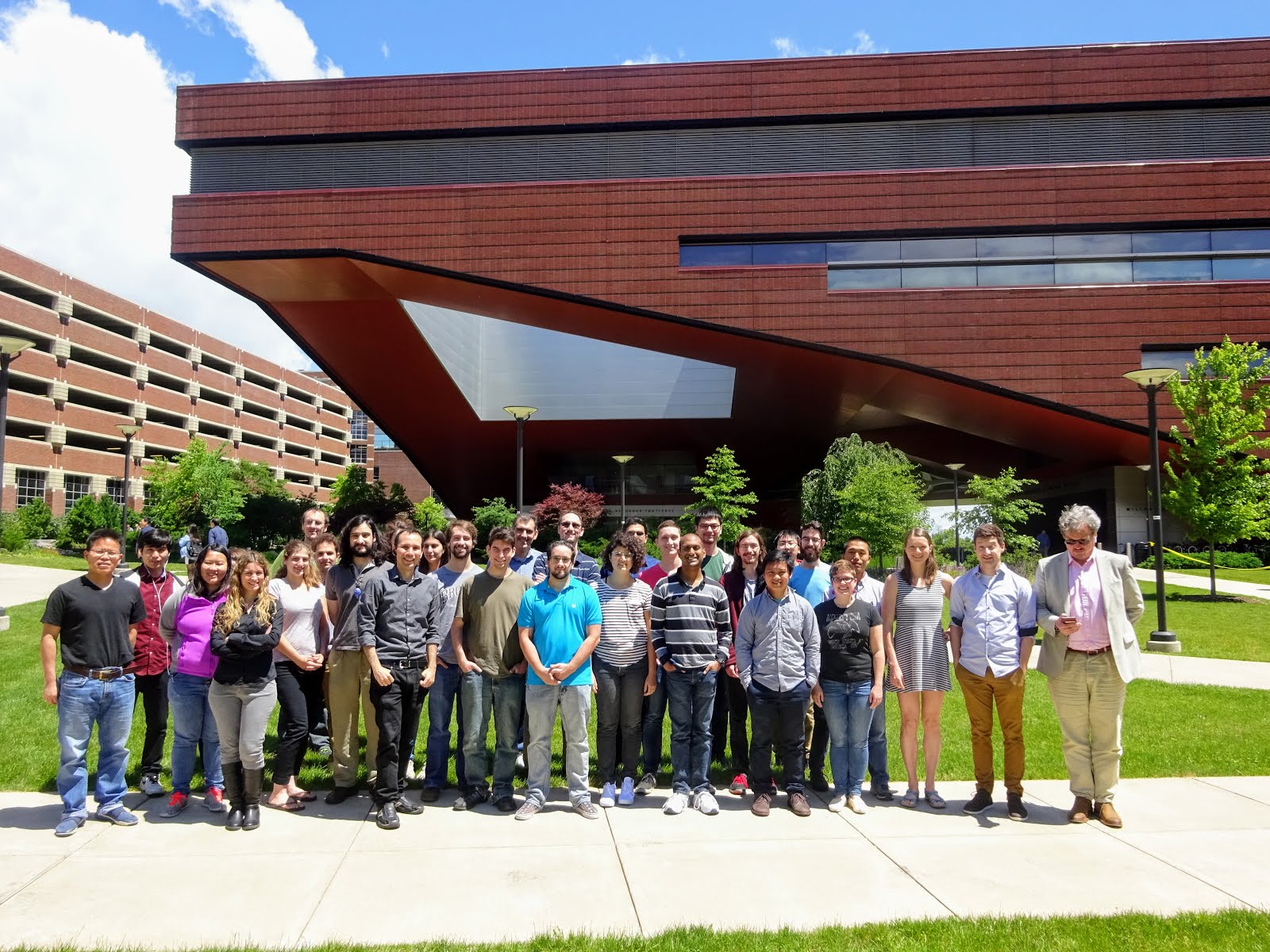
Today was the last day of the Project 8 Collaboration Meeting and Workshop, hosted by Prof. Luiz de Viveiros at Penn State.  The collaboration meeting brought >20 physicists from several institutions in the Project 8 collaboration for a week-long event here at Penn State, in which we discussed the status of the experiment and plans for the future.  We hope that all our guests enjoyed their time at Penn State!

Project 8 Collaboration Meeting at Penn State, Fall 2017


Tuesday, October 31, 2017

Dark Matter Day!

The LUX/LZ and LIGO groups at Penn State team up to celebrate Dark Matter Day! Physics students and postdocs host an information booth to explore the science of dark matter and the experiments looking for it!

DON’T BE AFRAID OF THE DARK!

darkmatterday.com

(Thank you to Emily Grace, Ryan Magee, Jacob McLaughlin, Nick Fassino and Corey Herr for preparing the booth and teaching the students about dark matter!)

Dark Matter Day information booth at the HUB - Corey Herr and Nick Fassino (physics undergrads) hosting the booth and "baiting" students with chocolate (dark, obviously!).


Dark Matter Day information booth at the HUB - Corey Herr explaining to undergrads the mysteries of dark matter and the intricacies of the LZ experiment!

Thursday, October 05, 2017

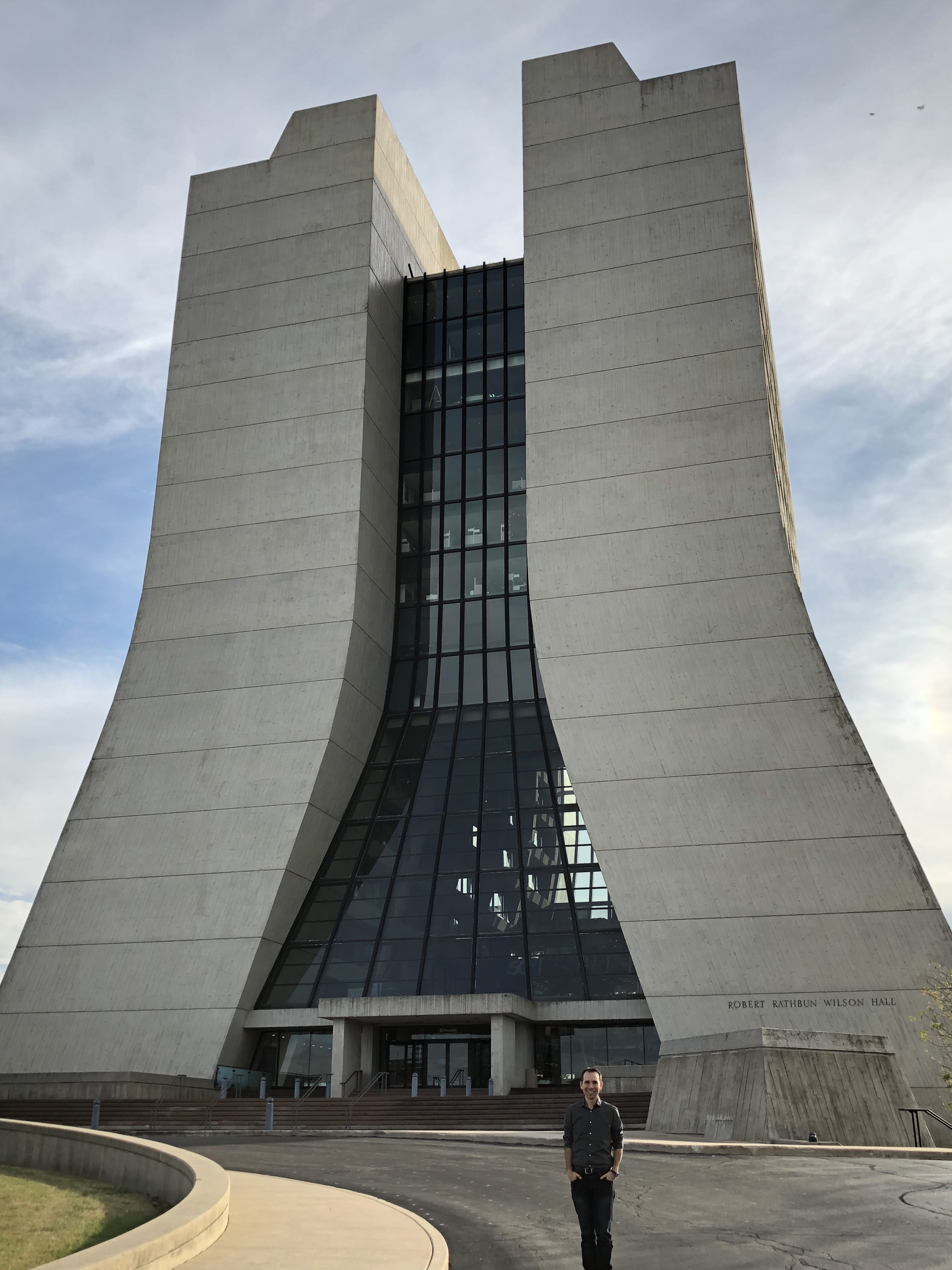
LZ Technical Collaboration Meeting at Fermilab


Prof. Luiz de Viveiros is out on Fermilab for the LZ Technical Collaboration Meeting!   The meeting is focused on technical reviews of the various subsystems for the LZ Dark Matter experiment, to make sure everything is on track for an early 2020 start date!

Friday, June 09, 2017

LUX Analysis Workshop at Penn State

Prof. Carmen Carmona hosted the LUX Analysis Workshop from June 5 to 9 at Penn State, a week-long event in which >30 physicists from several institutions in the LUX Dark Matter Experiment met at Penn State (with a few more calling in) to discuss the status, plans and techniques for the analysis of LUX data. The workshop focused on training new students and engaging current collaboration members to push forward the analysis of LUX data following the end of the experiment in late 2016. We hope the event was fruitful and fun, and that all visitors enjoyed their stay at Penn State!


Thursday, March 30, 2017

Project 8 Collaboration Meeting at MIT

The Project 8 collaboration gathers at MIT to discuss previous results and future plans, in preparation for the start of our first Tritium run, expected to happen by this Summer. This will be the first use in Tritium of the Cyclotron Radiation Emission Spectroscopy (CRES) technique pioneered by Project 8, and is expected to deliver groundbreaking results for future measurements of the neutrino mass!

Prof. Luiz de Viveiros at the Project 8 Collaboration Meeting at MIT, March 20, 2017.

Saturday, March 11, 2017

LZ Collaboration Meeting at SLAC

Carmen presents an update on the LZ Dark Matter sensitivity projections at the LZ Collaboration Meeting at SLAC (Menlo Park, CA)!

http://sites.psu.edu/particleastro/2017/03/11/lz-collaboration-meeting-at-slac/

Monday, February 27, 2017

LZ on Penn State News!

"Assistant Professor of Physics Luiz de Viveiros and the LUX detector inside the water tank just before it was filled with 72,000 gallons of ultra-purified water, which helps to shield it from cosmic rays and other radiation that would interfere with a dark matter signal. LUX was removed in 2016, and the tank will be used to house the LUX-ZEPLIN detector."
Our press release got published on the Penn State News!

http://news.psu.edu/story/452721/2017/02/24/next-generation-dark-matter-detector-race-finish-line

This is a note about LZ being given CD3 approval by the Department of Energy (DOE). This is of special importance because it indicates approval of the final design and formally launches construction of the experiment!

Saturday, February 18, 2017

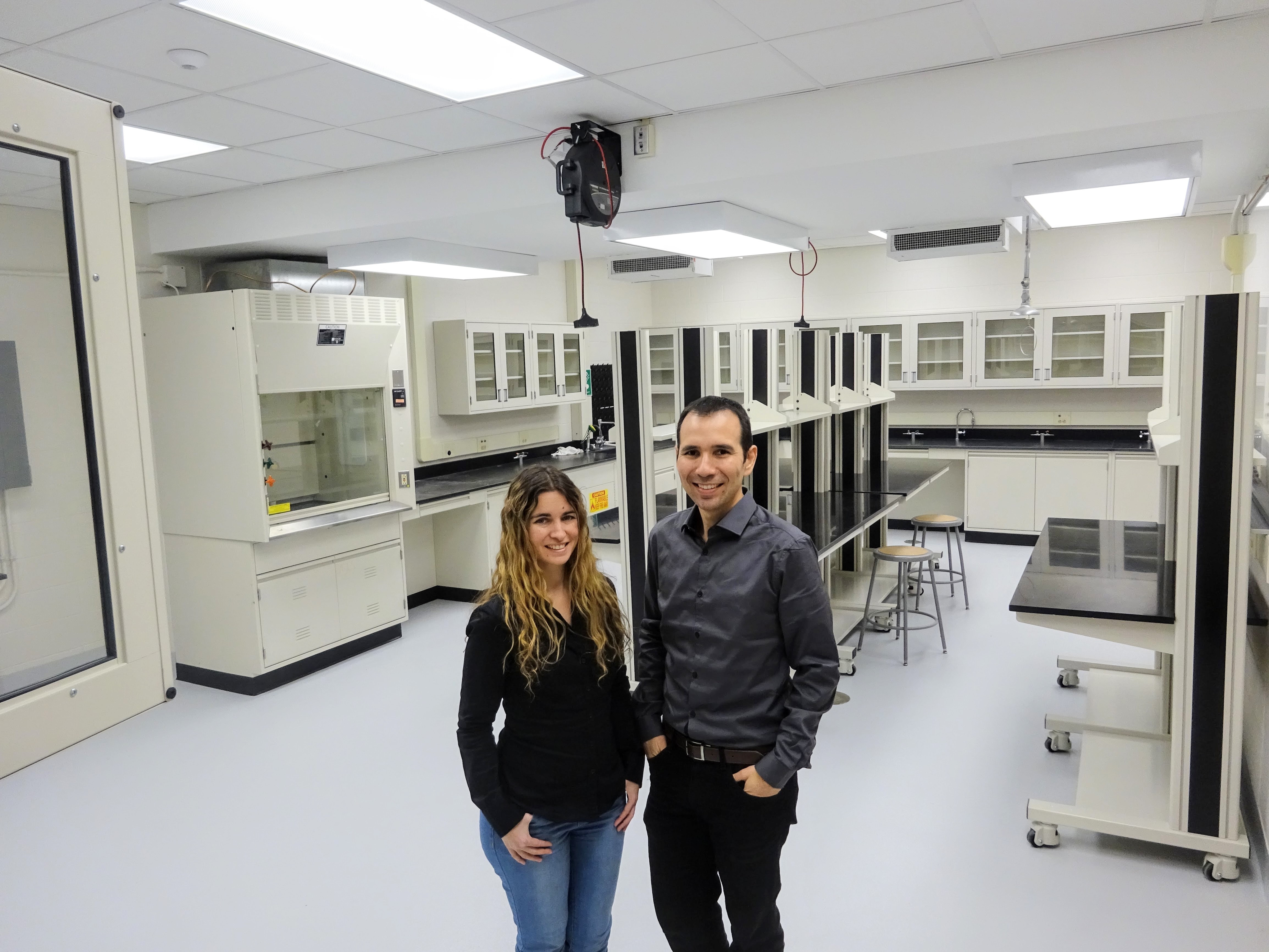
Davey 012 – New Lab ready!

Profs Carmen Carmona and Luiz de Viveiros in the first of their new labs at Penn State, Davey 012.

Our group is getting two new labs in the basement of the Davey Lab building, and the first one (Davey 012) is ready for occupancy!

Sunday, June 19, 2016

Review: The Day of the Triffids

The Day of the Triffids The Day of the Triffids by John Wyndham
My rating: 4 of 5 stars

This is a surprisingly good read! I only picked up on a friends very strong recommendation; based on the title, melodramatic cover and trite premise, it looked like it was going to be just another trashy sci-fi story; wow, was I wrong!

The beginning is very well written and very intriguing, it pulls you in right away. The book tells a story of survival in a post-apocalyptic world, where the thing that destroyed mankind was *blindness*, not the titular Triffids. After a strange meteor shower, the vast majority of people wake up blind, and only a few are left with sight. Society quickly disintegrates, people turn against each other, or abandon each other to misery and death. And as the world crumbles, a new power emerge: the triffids, giant walking killer plants that suddenly find themselves at the top of the food chain, so to speak (they don’t actually eat people, just kill them). This happens over a long time, the title is actually misleading - the rise of the triffids doesn’t happen in a single day, but over a long period. They are not a catastrophe, but rather a constant threat that keeps the remainder of mankind on its toes.

This is one of the first books of post-apocalyptical survivor horror, a precursor to the zombie apocalypse genre -and true to the genre, the scariest monsters are not the triffids, but other people! The description of the end of society is quite chilling: everything falls apart because of a single detail (blindness), which turned out to be crucial to pretty much everything. Questions of what is right and wrong are constant themes, and never quite resolved: how do you help so many helpless people? is a quick death better than a slow one? how do you rebuild? who do you rescue? what morals are artifacts of our comfortable lives, which ones are worth keeping? This might cause the reader some discomfort, and possibly some nightmares about going blind. The story really makes you think; at first, “no, it wouldn’t be so bad”, followed by “oh my god, it would be that bad!”.

The book is not without its weakness. For example, some of its sci-fi aspects are very strange and unlikely (like the blindness), although the author leaves the mechanism unspecified, so one can imagine it freely. The author is also an elitist and seems to think that helping others is ultimately a recipe for disaster (and he tries very hard to make that point, heaping misfortune upon misfortune whenever sighted people try to help the blind). However, the biggest weakness of the book is the clear and pervasive sexism of the author and characters; the description of gender roles are a firmly planted in the 50s, when the book was written. It might feel a little dated, but then again sexism is still everywhere, so it’s not that dated.

In the end, though, it’s still a very good story and a well written book!

View all my reviews

Sunday, June 05, 2016

Review: The Adventures of Huckleberry Finn

The Adventures of Huckleberry Finn The Adventures of Huckleberry Finn by Mark Twain
My rating: 3 of 5 stars

"The Adventures of Huckleberry Finn” is widely recognized as one of the great American novels, and it is certainly a good read. However, I personally don’t think it aged well, and the humor and adventure is sometimes lacking. Still, it paints an interesting and complex picture of the period. It tries to be funny and enjoyable at times, like the dialogue with Jim, and the parts with the “Duke" and the “King”; and it also depicts some dark moments, like Hucks imprisonment and beatings by his father, and the lot of runaway slaves. However, even these dark moments are described in such a matter of fact way, and surrounded by so much irony and little morsels of humor, that completely remove the drama from the story. The best example of this is the ending, which has already been heavily criticized by other readers: after Jim is captured, Huck and Tom Sawyer come up with the most ridiculous plans to rescue him, delaying the escape for weeks and putting Jim through a lot of trouble, which he innocently puts up with. It makes light of Jim’s situation, but I think this is done to symbolize the almost total blindness of the white people to the plight of the slaves; Tom Sawyer is the symbol of how entitled and detached the people with money are, even when they are the nice guys.

Regarding the story as a whole, I will only say that it is a series of coincidences and weird situations that Huck gets into, sometimes humorous, sometimes hinting at some lesson, sometimes verging on the ridiculous. Instead of a deeper analysis, I will just quote the author:

"Persons attempting to find a motive in this narrative will be prosecuted; persons attempting to find a moral in it will be banished; persons attempting to find a plot in it will be shot."

As for the language, I think it’s wonderful that Mark Twain tries to capture the way people thought and talked at the time, and makes reading this book even more interesting. After all, I think this book is worthwhile for its historical significance and depictions, rather than for its story.

View all my reviews

Wednesday, May 18, 2016

Review: All the Birds in the Sky

All the Birds in the Sky All the Birds in the Sky by Charlie Jane Anders
My rating: 4 of 5 stars

It’s an excellent book, with a story blending sci-fi and fantasy: a love story about a witch and a mad scientist. It's not a unique style, as some reviewers say - I think it reads like a Neil Gaiman or Terry Pratchett or Douglas Adams book (minus the absurdism of the latter two). The beginning is whimsical like a Neil Gaiman or Terry Pratchett, and it’s peppered with the sci-fi that you are likely to encounter in Terry Pratchett’s or Douglas Adams’ books - nothing too technical nor hard science, but enough realism to make it interesting. The world in the book is similar to our own, a few years in the future, but where magic is real and sci-fi staples are common; for example, time machine schematics can be downloaded from the web, and built by anyone with enough engineering skills. This world is very Bay-area-centered, not only because the story is geographically centered in San Francisco, but also in its ideas, themes, and the feel of it. The author is a well-known techie, so this makes sense. Sometimes this is cool, as it drags the classic sci-fi and fantasy elements into our modern world; sometimes it’s a bit annoying, as it describe life as a series of social events, going to the latest precious restaurant/artsy party/coffee house, which might be what is life is like for some people, but in this book it’s like that for every single character; and sometimes it’s completely non-sensical, like having the latest physics theories and breakthroughs happening in tech start-ups, rather than in universities and research institutes where they actually happen in reality. I guess the author is enamored with the idea that Steve Jobs or Elon Musk are the new rock-stars/prophets/saviors of the world, but it’s still jarring to see such basic misunderstanding of the enterprise of science.

However, the world and world-building are secondary to the book; this is really a love story, and the book pays a lot of attention to the two main characters, their background, and their relationship. Although there are huge gaps in the continuity, I think it does an excellent job of following the main couple and their character growth (and sometimes lack thereof), taking it slow whenever possible, and throwing in some fast paced action. Although sometimes the book is annoying in its world-building, and sometimes annoying in how obtuse the main characters are (a lot of grief could have saved by a simple conversation early on), for the most part it’s a sweet story, and a lot of fun too!

View all my reviews

Sunday, March 20, 2016

Review: The Girl on the Train

The Girl on the Train The Girl on the Train by Paula Hawkins
My rating: 3 of 5 stars

I picked up this book *exactly* because I enjoyed the movie “Gone Girl”, and lots of reviews characterized this as a grittier and faster “Gone Girl”. I have enjoyed it, and the comparisons to the aforementioned hit is unavoidable. Since I didn’t actually read “Gone Girl” (only saw the movie), I cannot say whether it’s grittier and faster-paced, but it didn’t strike me as either.

What did strike me was the character building in the book. The small cast is well developed, with layers upon layers of reasons, secrets, regrets, desires, and all sorts of emotional baggage. Not that there aren’t any holes in the characters stories - there are huge gaps in their history, in their thinking, there are many things that get only alluded to but never explained. Also, I get the impression that the author (a woman) and her characters are all basically sexists; the women are defined by their relationship to men, and by their pregnancies and kids, while the men are mostly misogynist sociopaths. Still, they are all complex, realistic and generally messed up individuals (hey, all societies are full of women and men just like that!).

The story centers on Rachel, an alcoholic whose life is in shambles, but that one day witnesses something from the train that puts her in the middle of a murder mystery. Her story is tortuous, sometimes torturous; it’s painful to hear it. This is not an action-packed thriller, it’s a slow unraveling of people and mysteries. I found it very enthralling; I suppose it’s a car-crash rubbernecking effect. The denouement is not specially surprising, but the execution is good enough. In the end, it’s an interesting read.

View all my reviews

Sunday, March 06, 2016

Review: A Short Stay in Hell

A Short Stay in Hell A Short Stay in Hell by Steven L. Peck
My rating: 5 of 5 stars

A fascinating short-story! It tells the story of a man sent to hell, through no fault of his own - he simply didn’t follow the True Religion (spoiler alert - it’s none of the major ones!). His version of hell is a gigantic library, in which the word gigantic is a terrible understatement; it contains all the books that were and could be written, including all possible garbled text. The dammed must search the library until they find the book that contains the story of their life. The setting is inspired by Jorge Luis Borges’s Library of Babylon, and the book perfectly invokes Borges’s writing and feel. It is interesting, funny, perverse, sad, full of anguish, it makes you think; it’s a really well done work. At times I think the only fault is that it is too short; I want read more about it! But I came to the conclusion that it is exactly as it must be - full of mystery, of unrealized wishes, and of longing. A must-read!

View all my reviews