Tuesday, October 31, 2017

Dark Matter Day!

The LUX/LZ and LIGO groups at Penn State team up to celebrate Dark Matter Day! Physics students and postdocs host an information booth to explore the science of dark matter and the experiments looking for it!

DON’T BE AFRAID OF THE DARK!

darkmatterday.com

(Thank you to Emily Grace, Ryan Magee, Jacob McLaughlin, Nick Fassino and Corey Herr for preparing the booth and teaching the students about dark matter!)

Dark Matter Day information booth at the HUB - Corey Herr and Nick Fassino (physics undergrads) hosting the booth and "baiting" students with chocolate (dark, obviously!).


Dark Matter Day information booth at the HUB - Corey Herr explaining to undergrads the mysteries of dark matter and the intricacies of the LZ experiment!

Thursday, October 05, 2017

LZ Technical Collaboration Meeting at Fermilab


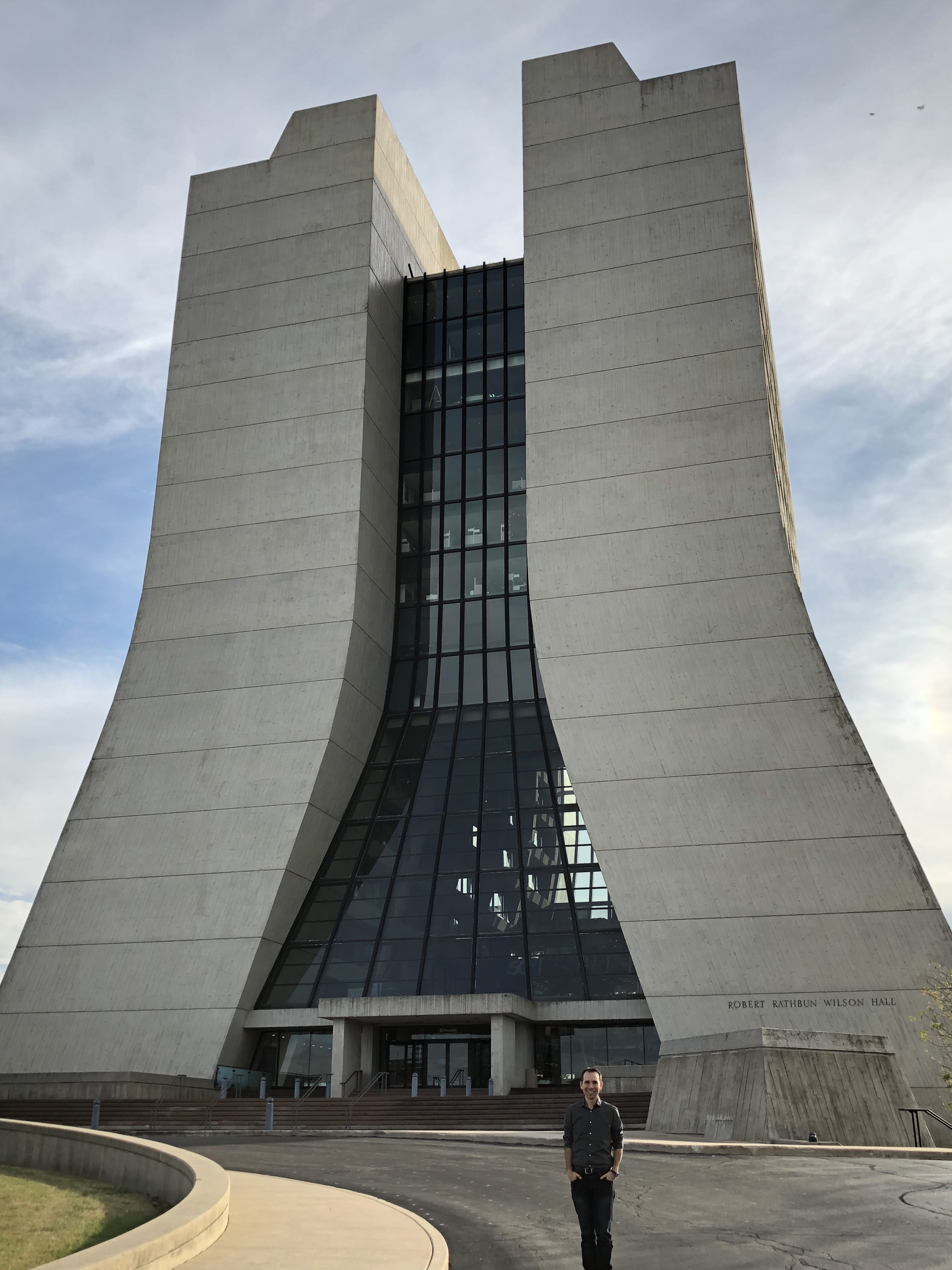
Prof. Luiz de Viveiros is out on Fermilab for the LZ Technical Collaboration Meeting!   The meeting is focused on technical reviews of the various subsystems for the LZ Dark Matter experiment, to make sure everything is on track for an early 2020 start date!

Friday, June 09, 2017

LUX Analysis Workshop at Penn State

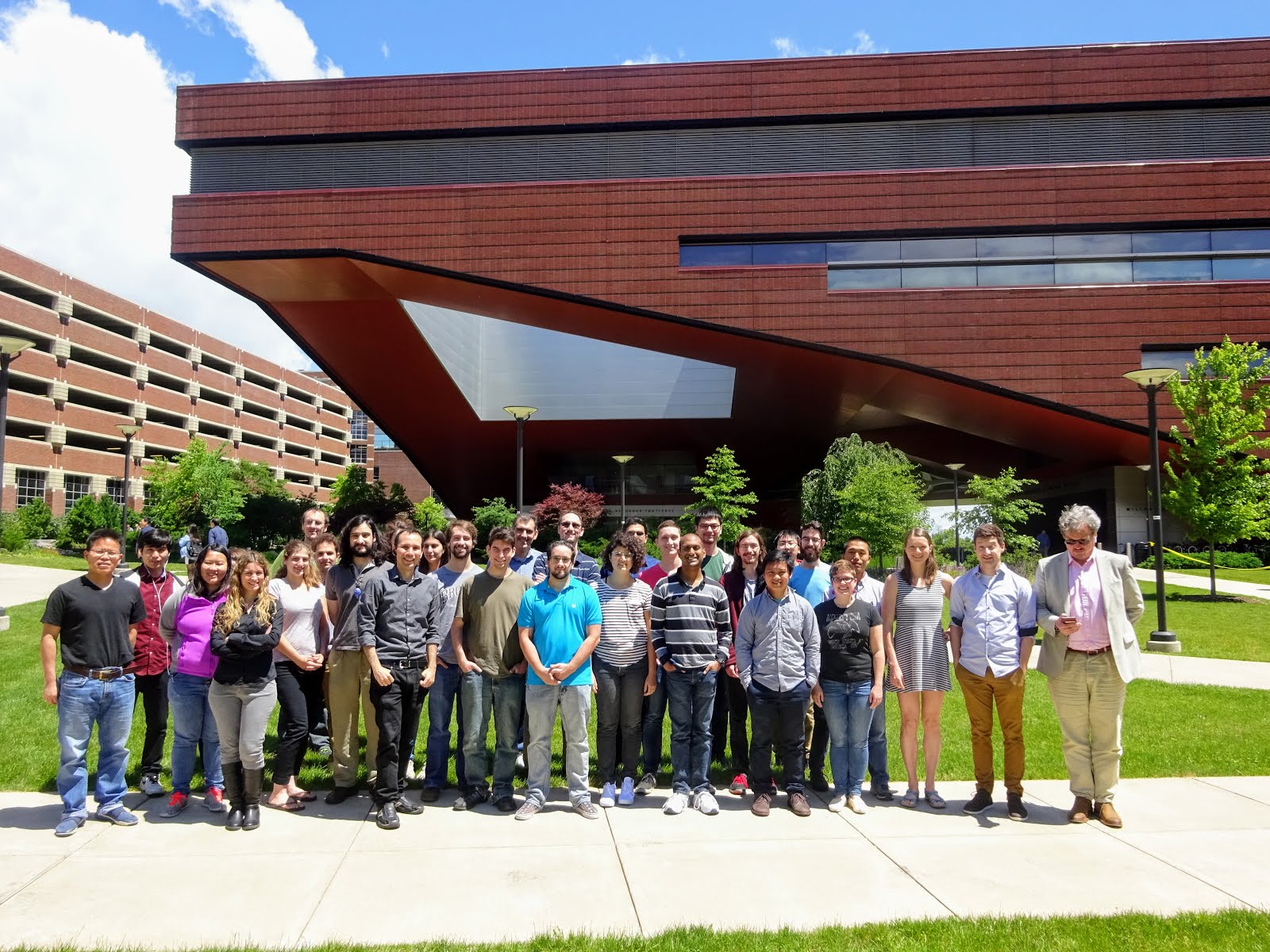
Prof. Carmen Carmona hosted the LUX Analysis Workshop from June 5 to 9 at Penn State, a week-long event in which >30 physicists from several institutions in the LUX Dark Matter Experiment met at Penn State (with a few more calling in) to discuss the status, plans and techniques for the analysis of LUX data. The workshop focused on training new students and engaging current collaboration members to push forward the analysis of LUX data following the end of the experiment in late 2016. We hope the event was fruitful and fun, and that all visitors enjoyed their stay at Penn State!


Thursday, March 30, 2017

Project 8 Collaboration Meeting at MIT

The Project 8 collaboration gathers at MIT to discuss previous results and future plans, in preparation for the start of our first Tritium run, expected to happen by this Summer. This will be the first use in Tritium of the Cyclotron Radiation Emission Spectroscopy (CRES) technique pioneered by Project 8, and is expected to deliver groundbreaking results for future measurements of the neutrino mass!

Prof. Luiz de Viveiros at the Project 8 Collaboration Meeting at MIT, March 20, 2017.

Saturday, March 11, 2017

LZ Collaboration Meeting at SLAC

Carmen presents an update on the LZ Dark Matter sensitivity projections at the LZ Collaboration Meeting at SLAC (Menlo Park, CA)!

http://sites.psu.edu/particleastro/2017/03/11/lz-collaboration-meeting-at-slac/

Monday, February 27, 2017

LZ on Penn State News!

"Assistant Professor of Physics Luiz de Viveiros and the LUX detector inside the water tank just before it was filled with 72,000 gallons of ultra-purified water, which helps to shield it from cosmic rays and other radiation that would interfere with a dark matter signal. LUX was removed in 2016, and the tank will be used to house the LUX-ZEPLIN detector."
Our press release got published on the Penn State News!

http://news.psu.edu/story/452721/2017/02/24/next-generation-dark-matter-detector-race-finish-line

This is a note about LZ being given CD3 approval by the Department of Energy (DOE). This is of special importance because it indicates approval of the final design and formally launches construction of the experiment!

Saturday, February 18, 2017

Davey 012 – New Lab ready!

Profs Carmen Carmona and Luiz de Viveiros in the first of their new labs at Penn State, Davey 012.

Our group is getting two new labs in the basement of the Davey Lab building, and the first one (Davey 012) is ready for occupancy!

Sunday, June 19, 2016

Review: The Day of the Triffids

The Day of the Triffids The Day of the Triffids by John Wyndham
My rating: 4 of 5 stars

This is a surprisingly good read! I only picked up on a friends very strong recommendation; based on the title, melodramatic cover and trite premise, it looked like it was going to be just another trashy sci-fi story; wow, was I wrong!

The beginning is very well written and very intriguing, it pulls you in right away. The book tells a story of survival in a post-apocalyptic world, where the thing that destroyed mankind was *blindness*, not the titular Triffids. After a strange meteor shower, the vast majority of people wake up blind, and only a few are left with sight. Society quickly disintegrates, people turn against each other, or abandon each other to misery and death. And as the world crumbles, a new power emerge: the triffids, giant walking killer plants that suddenly find themselves at the top of the food chain, so to speak (they don’t actually eat people, just kill them). This happens over a long time, the title is actually misleading - the rise of the triffids doesn’t happen in a single day, but over a long period. They are not a catastrophe, but rather a constant threat that keeps the remainder of mankind on its toes.

This is one of the first books of post-apocalyptical survivor horror, a precursor to the zombie apocalypse genre -and true to the genre, the scariest monsters are not the triffids, but other people! The description of the end of society is quite chilling: everything falls apart because of a single detail (blindness), which turned out to be crucial to pretty much everything. Questions of what is right and wrong are constant themes, and never quite resolved: how do you help so many helpless people? is a quick death better than a slow one? how do you rebuild? who do you rescue? what morals are artifacts of our comfortable lives, which ones are worth keeping? This might cause the reader some discomfort, and possibly some nightmares about going blind. The story really makes you think; at first, “no, it wouldn’t be so bad”, followed by “oh my god, it would be that bad!”.

The book is not without its weakness. For example, some of its sci-fi aspects are very strange and unlikely (like the blindness), although the author leaves the mechanism unspecified, so one can imagine it freely. The author is also an elitist and seems to think that helping others is ultimately a recipe for disaster (and he tries very hard to make that point, heaping misfortune upon misfortune whenever sighted people try to help the blind). However, the biggest weakness of the book is the clear and pervasive sexism of the author and characters; the description of gender roles are a firmly planted in the 50s, when the book was written. It might feel a little dated, but then again sexism is still everywhere, so it’s not that dated.

In the end, though, it’s still a very good story and a well written book!

View all my reviews

Sunday, June 05, 2016

Review: The Adventures of Huckleberry Finn

The Adventures of Huckleberry Finn The Adventures of Huckleberry Finn by Mark Twain
My rating: 3 of 5 stars

"The Adventures of Huckleberry Finn” is widely recognized as one of the great American novels, and it is certainly a good read. However, I personally don’t think it aged well, and the humor and adventure is sometimes lacking. Still, it paints an interesting and complex picture of the period. It tries to be funny and enjoyable at times, like the dialogue with Jim, and the parts with the “Duke" and the “King”; and it also depicts some dark moments, like Hucks imprisonment and beatings by his father, and the lot of runaway slaves. However, even these dark moments are described in such a matter of fact way, and surrounded by so much irony and little morsels of humor, that completely remove the drama from the story. The best example of this is the ending, which has already been heavily criticized by other readers: after Jim is captured, Huck and Tom Sawyer come up with the most ridiculous plans to rescue him, delaying the escape for weeks and putting Jim through a lot of trouble, which he innocently puts up with. It makes light of Jim’s situation, but I think this is done to symbolize the almost total blindness of the white people to the plight of the slaves; Tom Sawyer is the symbol of how entitled and detached the people with money are, even when they are the nice guys.

Regarding the story as a whole, I will only say that it is a series of coincidences and weird situations that Huck gets into, sometimes humorous, sometimes hinting at some lesson, sometimes verging on the ridiculous. Instead of a deeper analysis, I will just quote the author:

"Persons attempting to find a motive in this narrative will be prosecuted; persons attempting to find a moral in it will be banished; persons attempting to find a plot in it will be shot."

As for the language, I think it’s wonderful that Mark Twain tries to capture the way people thought and talked at the time, and makes reading this book even more interesting. After all, I think this book is worthwhile for its historical significance and depictions, rather than for its story.

View all my reviews

Wednesday, May 18, 2016

Review: All the Birds in the Sky

All the Birds in the Sky All the Birds in the Sky by Charlie Jane Anders
My rating: 4 of 5 stars

It’s an excellent book, with a story blending sci-fi and fantasy: a love story about a witch and a mad scientist. It's not a unique style, as some reviewers say - I think it reads like a Neil Gaiman or Terry Pratchett or Douglas Adams book (minus the absurdism of the latter two). The beginning is whimsical like a Neil Gaiman or Terry Pratchett, and it’s peppered with the sci-fi that you are likely to encounter in Terry Pratchett’s or Douglas Adams’ books - nothing too technical nor hard science, but enough realism to make it interesting. The world in the book is similar to our own, a few years in the future, but where magic is real and sci-fi staples are common; for example, time machine schematics can be downloaded from the web, and built by anyone with enough engineering skills. This world is very Bay-area-centered, not only because the story is geographically centered in San Francisco, but also in its ideas, themes, and the feel of it. The author is a well-known techie, so this makes sense. Sometimes this is cool, as it drags the classic sci-fi and fantasy elements into our modern world; sometimes it’s a bit annoying, as it describe life as a series of social events, going to the latest precious restaurant/artsy party/coffee house, which might be what is life is like for some people, but in this book it’s like that for every single character; and sometimes it’s completely non-sensical, like having the latest physics theories and breakthroughs happening in tech start-ups, rather than in universities and research institutes where they actually happen in reality. I guess the author is enamored with the idea that Steve Jobs or Elon Musk are the new rock-stars/prophets/saviors of the world, but it’s still jarring to see such basic misunderstanding of the enterprise of science.

However, the world and world-building are secondary to the book; this is really a love story, and the book pays a lot of attention to the two main characters, their background, and their relationship. Although there are huge gaps in the continuity, I think it does an excellent job of following the main couple and their character growth (and sometimes lack thereof), taking it slow whenever possible, and throwing in some fast paced action. Although sometimes the book is annoying in its world-building, and sometimes annoying in how obtuse the main characters are (a lot of grief could have saved by a simple conversation early on), for the most part it’s a sweet story, and a lot of fun too!

View all my reviews

Sunday, March 20, 2016

Review: The Girl on the Train

The Girl on the Train The Girl on the Train by Paula Hawkins
My rating: 3 of 5 stars

I picked up this book *exactly* because I enjoyed the movie “Gone Girl”, and lots of reviews characterized this as a grittier and faster “Gone Girl”. I have enjoyed it, and the comparisons to the aforementioned hit is unavoidable. Since I didn’t actually read “Gone Girl” (only saw the movie), I cannot say whether it’s grittier and faster-paced, but it didn’t strike me as either.

What did strike me was the character building in the book. The small cast is well developed, with layers upon layers of reasons, secrets, regrets, desires, and all sorts of emotional baggage. Not that there aren’t any holes in the characters stories - there are huge gaps in their history, in their thinking, there are many things that get only alluded to but never explained. Also, I get the impression that the author (a woman) and her characters are all basically sexists; the women are defined by their relationship to men, and by their pregnancies and kids, while the men are mostly misogynist sociopaths. Still, they are all complex, realistic and generally messed up individuals (hey, all societies are full of women and men just like that!).

The story centers on Rachel, an alcoholic whose life is in shambles, but that one day witnesses something from the train that puts her in the middle of a murder mystery. Her story is tortuous, sometimes torturous; it’s painful to hear it. This is not an action-packed thriller, it’s a slow unraveling of people and mysteries. I found it very enthralling; I suppose it’s a car-crash rubbernecking effect. The denouement is not specially surprising, but the execution is good enough. In the end, it’s an interesting read.

View all my reviews

Sunday, March 06, 2016

Review: A Short Stay in Hell

A Short Stay in Hell A Short Stay in Hell by Steven L. Peck
My rating: 5 of 5 stars

A fascinating short-story! It tells the story of a man sent to hell, through no fault of his own - he simply didn’t follow the True Religion (spoiler alert - it’s none of the major ones!). His version of hell is a gigantic library, in which the word gigantic is a terrible understatement; it contains all the books that were and could be written, including all possible garbled text. The dammed must search the library until they find the book that contains the story of their life. The setting is inspired by Jorge Luis Borges’s Library of Babylon, and the book perfectly invokes Borges’s writing and feel. It is interesting, funny, perverse, sad, full of anguish, it makes you think; it’s a really well done work. At times I think the only fault is that it is too short; I want read more about it! But I came to the conclusion that it is exactly as it must be - full of mystery, of unrealized wishes, and of longing. A must-read!

View all my reviews

Monday, February 29, 2016

"Dead Pig Collector" by Warren Ellis

Dead Pig CollectorDead Pig Collector by Warren Ellis
My rating: 3 of 5 stars

A short-story about a contract killer in LA. That might sound like a cliche, but the story has a different take on it; our contract killer is a methodical, disciplined, cold hitman, and meets a geek-girl in the autistic spectrum; it’s love at first blood! The beginning of the story was boring and almost made me stop, but once the girl shows up, the story picked up and made me wonder where this is going. In the end, it was an interesting read, and a good addition to the crime genre.

View all my reviews

Friday, February 19, 2016

"The Playground", by Ray Bradbury

The PlaygroundThe Playground by Ray Bradbury
My rating: 2 of 5 stars

A creepy short-story. Although written by one of the masters of sic-fi, there is no sci-fi here at all, it’s more like a weird horror story. It’s well written, and it successfully sets up a creepy atmosphere; but the characters and situations are not relatable, so it’s not really that great of a story.

View all my reviews

Wednesday, February 10, 2016

"The Proxy Marriage" by Maile Meloy

The Proxy MarriageThe Proxy Marriage by Maile Meloy
My rating: 3 of 5 stars

This short story is a cute romantic-comedy, inspired by the weird concept of “proxy marriage”, which is real and legal in the US! It’s a standard love story, with a twist: boy meets girl, falls in love, marries her, then marries her again, and again, and again, only not really because they are just stand-ins in a proxy marriage! It’s a good, quick read.

View all my reviews

Tuesday, January 26, 2016

"Blood Meridian" by Cormac McCarthy

Blood Meridian, or the Evening Redness in the WestBlood Meridian, or the Evening Redness in the West by Cormac McCarthy
My rating: 1 of 5 stars

It’s difficult to write about this book, mainly because it’s missing many features you expect in a book - there is no plot, there is no hero, and no real antagonist. It’s just a series of random events, sprinkled with some supposedly shocking violence. However, it’s not even that shocking. Perhaps back in the day it would be, but certainly not today. It’s strange, because his descriptions of the violence are at the same time very matter-of-fact and filled with flourishing language; in both extremes, the author fails to cause shock or to make it interesting; it’s just boring. The events are barely connected together, we just go to one place to another, people kill each other for no reason, we are letting wondering “but why is he chasing that guy? why did he shoot him? what just happened?” I kept going back to see if I missed something, but no, there is nothing. Things just happen. Although there was no plot, there was a story. We follow a “kid” traveling through the west, joining a couple of mercenary gangs causing death and mayhem through Mexico and California. The narrative makes sense, it serves its purpose of describing the Old West in a realistic way, brutal and raw and miserable. But that’s it. It felt like a waste of time and I would definitely not recommend it.

View all my reviews

Wednesday, November 18, 2015

The Legend of Sleepy Hollow, by Washington Irving

The Legend of Sleepy HollowThe Legend of Sleepy Hollow by Washington Irving
My rating: 4 of 5 stars

The story is short, but it’s pretty good. The writing is clever and surprisingly witty, even today. It’s clear that the protagonist is not the famous "headless horseman”, but Icabod Crane; whether we are supposed to like him or despise him is less clear. He is described in terms at times contemptuous, at times in jest, at times making excuses for him. Maybe he is just a product of the times. Most likely the author intended him as a caricature. But in any case, the descriptions are great, and the setup is done slowly and carefully. Bear in mind that the story is pretty much just one short event; everything is in the setup. The only fault is how short it was!

View all my reviews

Wednesday, October 21, 2015

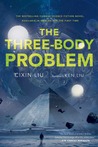
"The Three-Body Problem" by Liu Cixin

The Three-Body Problem (Three-Body, #1)The Three-Body Problem by Liu Cixin
My rating: 3 of 5 stars

The Three-Body Problem tells the story of an Alien Invasion; but it’s an unusual invasion, told in an unusual way. The book was a big hit in China where it was written, and it has gained lots of critical praise and achieved international success. I can see the appeal of the book right in the first few pages. It has an explosive start, right in the middle of the Cultural Revolution, giving an unprecedented look into modern Chinese history - at least unprecedented for Western readers, where a deep look into Chinese history and culture might feel like a look into an alien empire! It is a horrific setting, full of corruption and threats.

Its appeal might also stem from its first main character: a strong female lead, incorruptible and stoic, surrounded by corrupt men using the revolution for their own political gain, or at least to protect themselves from the witch-hunt that was the revolution.

The book seems to have been written by someone who likes physics, but is not a physicist; and from its tone, it seems aimed at people in the hard sciences. It uses a lot of jargon and scientific details. I am a physicist, and I don’t see how other people can appreciate all the details and nuances (could a lay person understand the importance of chaotic systems?). At the same time, the science has been dumbed down - for accessibility sake, I hope, rather than a failure of the author. Also, it has a grandiose prose that no physicist would use when describing his/her work; it sounds the kind of language a physicist would use when giving an interview to a non-scientific publication, and is trying to get an impressive soundbyte in; but instead of just a few grandiose lines, it’s the entire book. Perhaps this is indicative that the author has learned everything from popular publications, rather than actual study.

Then we get to the revelations of the second and of third part, when the author really seems to have no idea how physics works - both the science and how physicists work. First of all, the book describes a four-body problem, not a three-body problem - it’s hard to tell if the author is aware of that. He then talks about physicists hushing the results from accelerator experiments, as if the work wasn’t completely public (just look at the amount of press and information leaked about the LHC, and the big hoopla every time there is a hint of something weird). Towards the end, there is a lot of talk about extra dimensions, and it’s so out there that it feels more like wizard fantasy than science fiction.

The whole second part is very weird, and reads like one of those Japanese existentialist/fantastical mysteries, with a little bit of sci-fi thrown in. The characters behave in very “arbitrary” ways (that is, serving the purpose of the narrative, but not in a way that normal people would behave), and talk in a very flourished manner, so their behavior and speech is not natural at all (although that could be due to the translation from Chinese to English). Another thing I didn’t like is that the whole book also feels very elitist; it explicitly says several times that only the elites matter.

Despite its faults with the science and characters, the *story* is good. It has an incredible scope, starting in our history, bringing us to the present day and flinging us out into space. It keeps a good pace, and it’s constantly introducing us to new concepts and plot points. It builds slowly, but never slows down. There are several big reveals, but the plot never feels convoluted (only the science). It’s the kind of story in which there is a secret history / secret truth behind everything, and only a few are involved. On the other hand, it goes on the opposite direction of the “Chosen One” trope; the main characters are important to the world because of the work they do, because of the choices they made, and because of their sacrifices. The characters might speak and act in a weird way, but they aren’t flat at all; they have complex desires and driving forces. They get confused, they despair, they make mistakes, and they aren’t all good nor all bad. The conclusion is also just as ambiguous as the characters, and it feels satisfying. All in all, a good read.

View all my reviews

Sunday, September 20, 2015

Redshirts, by John Scalzi

RedshirtsRedshirts by John Scalzi
My rating: 4 of 5 stars

A very entertaining book!

It has a very strange story - actually, strange is the wrong word, it’s a *wild* story. It’s wild, crazy, mad! And it’s a lot of fun!

On top of all that, it has a serious philosophical discussion on the nature of reality, perception, and the anthropic principle; in this aspect, it’s like the Matrix movie, in that it manages to add some real philosophical questions to your entertainment.

And just when you think it’s all resolved, when you think that the meta-story has been told, you realize there are still a lot of pages left, and then you go up another level into another meta-meta-story, and who know how deep this thing goes. And *then* things go even further the deep end!

View all my reviews

Sunday, August 16, 2015

"Smoke and Mirrors" by Neil Gaiman

Smoke and MirrorsSmoke and Mirrors by Neil Gaiman
My rating: 3 of 5 stars

I am a huge fan of Neil Gaiman, but I found this to be a strange collection of tales. A lot of the stories are dark and depressing. While his work is mostly dark (he seems to specialize on retelling of myths and legends, with a twist), they are not usually this depressing. Also, they were not as interesting as most of his work. The problem might be that I had already read most of the short stories in this collection elsewhere, and the stuff that was new for me (that is, that didn’t make it to other collections) is exactly the least interesting of his stories.

I liked that H.P. Lovecraft kept popping up in a number of the stories, Gaiman makes good use of the Cthulhu mythos. The best stories for me were “The Price”, “Only the End of the World Again”, and of course “Murder Mysteries”, one of Gaiman’s all time greats; but I had already read these stories elsewhere, so as a whole, the collection was disappointing.

If you haven’t read Murder Mysteries, then by all means pick this book up and give it a try, otherwise, you’re safe skipping it.

View all my reviews