Sunday, July 12, 2015

"The Best of H.P. Lovecraft", by H.P. Lovecraft

The Best of H.P. Lovecraft: Bloodcurdling Tales of Horror and the MacabreThe Best of H.P. Lovecraft: Bloodcurdling Tales of Horror and the Macabre by H.P. Lovecraft
My rating: 4 of 5 stars

Excellent collection of the master of horror! I had read this already back in high school, but I didn’t remember much of it. I decided that since there are so many references to Lovecraft’s work all over the place (books, movies, games, comics, etc…), I should give it a re-read. One of the things I do remember was that it was scary. It’s not easy for a book to be scary - movies can easily make you jump, but without the benefit of graphic scenes and loud noises, a book has to do a lot more work to get you scared - and Lovecraft manages just that.

I was surprised by the variety of stories in this collection. A lot of the stories (and none of the earlier ones) stories have nothing to do with the Cthulhu mythos, and are your typical horror stories - an anecdote with a horror twist at the end. But it’s when he gets to the Cthulhu mythos that he really shows his mastery. Some of the stories start as a mystery or adventure story, salted heavily with allusions to hidden things, great mysteries, and “unspeakable horrors”. Despite the exaggerated foreshadowing, Lovecraft does construct a good story, with interesting plot devices (at one point, doom is predicted not by a person having a vision, but by a *statistical analysis* of dreams and visions over a period!), and cliffhangers. His stories sometime link in subtle ways too - you will recognize things in one story that got mentioned in another that in principle had nothing to do with it (they are not sequels), so you slowly get the feeling of a larger world with a lot going on underneath. Another things that surprised me is that this is very much a sci-fi book - the monsters are usually characterized as aliens, be it from other planets or from other “dimensions”. There is a lot of space travel, travel through the folding of space, and the importance of physics and mathematics to the stories. There are even mentions of Einstein, relativity, quantum physics !

The major downside of the book is how melodramatic his prose is, specially his use of adjectives. Halfway through the book, it starts getting repetitive, as there are only so many ways to preface the word horror: "indescribable horror”, “Cyclopean horror”, "realms of unfathomable horror and inconceivable abnormality”, etc…

There are also an immeasurable number of incongruences to his plots and plot devices. For example, in a few of his stories, there are all-powerful antagonists, ancient beings who have mastered all sorts of dark arts and can destroy all of humanity at a whim, and yet are foiled by dogs (“The Dunwich Horror”, “The Whisperer in Darkness”). Another example is how his characters are always getting horrified by architecture, geometry and language - really, how bad can it be? It makes it difficult to relate sometimes. When someone says how they were paralyzed with fear because of the horrible architecture of the place, it’s not easy to feel sympathetic. A passage says: "My head was aching, and I had a singular feeling that someone else was trying to get possession of my thoughts” You know that feeling that someone is trying to get possession of your thoughts? Yeah, me neither.

In the end, if you do get past all the melodrama, you get treated to a vast mythos, with creatures and legends that pop up all over the place (“ah, so this is where that comes from!”), and that have laid important foundations to the genre of horror and sic-fi.

View all my reviews

Monday, July 06, 2015

"The Gates", by John Connolly

The Gates (Samuel Johnson, #1)The Gates by John Connolly
My rating: 3 of 5 stars

Good book, it felt a lot like a Neil Gaiman story, but with a lot more pseudo-science, and a lot less obscure mythology.


View all my reviews

Wednesday, July 01, 2015

"Burnt Tongues", edited by Chuck Palahniuk

Burnt TonguesBurnt Tongues by Chuck Palahniuk
My rating: 3 of 5 stars

This book is a collection of short stories, edited by Chuck Palahniuk, the author of "Fight Club", or more relevantly, of “Guts” and “Haunted”. He characterizes these stories as “transgressive literature”, stuff that pushes the edge and sometimes go right past it. Basically, it’s stuff that should be taboo, or disgusting, or from the mind of a disturbed individual, definitely something you do not talk about in polite conversation; and it’s eye-opening and wildly entertaining!

If you have read “Guts”, “Haunted”, or some of Palahniuk’s short stories, then you know what this is about (“Fight Club” is tame by comparison). But while I love Palahniuk’s work, this collection is only so-so. The quality of the stories vary a lot. There are a few stories there (like the first one, “Live This Down") that feel like something that Palahniuk would have written himself, from the subject to the style to the dialogue, and most of them have themes that must make Palahniuk proud (like a Special Ed class revolting against a bully, with terrible consequences). But while all stories are “transgressive”, not all are entertaining. They touch on a taboo subject, describe it, then peter out. Most of them end in an anti-climax. They are good, but not great.

Still, there are some gems in there - again, “Live This Down”, and also “Ingredients”, “Dietary", “Heavier Petting” and “Zombie Whorehouse”, among others. They are not for everyone - they are twisted, messed up stuff. If you like crazy and you like it with style, pick this up, it’s a good read.

View all my reviews

Saturday, June 20, 2015

The Martian, by Andy Weir

The MartianThe Martian by Andy Weir
My rating: 5 of 5 stars


The book tells the story of Mark Watney, an astronaut left for dead in Mars. In his words:

“It was a ridiculous sequence of events that led to me almost dying. Then an even more ridiculous sequence that led to me surviving.”

It’s the early years of Mars exploration, humans have just reached it, and are doing some exploratory missions, very similar to the lunar missions. The author skips right over the question of why we went to Mars, and starts with the premise that we went, and are still sending a few more missions. An accident happens during the current mission, and one of the astronauts is left behind, his crew thinking he died. Now he is in Mars, alone, with very little supplies and no communication with Earth, and nobody knows he is alive! Somehow he must find a way to survive. Since it takes place in the near future, the book doesn’t have any apparent futuristic technology - some new materials used for construction, but everything else is pretty much current technology. It makes all the challenges and solutions very believable and relatable. The author goes to great lengths to describe the technical aspects of the problems that the Watney faces, and of the solutions he finds, but in a really interesting way - rather than dull commentary, he uses the descriptions as a way to build tension, or to make the action seem more fast-paced than it is (sounds counter-intuitive, but he really manages to do it). Watney is a really funny guy, and makes not only a great character but a great narrator. The book is quite an exciting and enjoyable adventure. It’s one of my favorite books in years.

(view spoiler)

View all my reviews

Thursday, June 18, 2015

Dark Matter Beer!

Finally some proper recognition: Dark Matter beer, in honor of the LUX Experiment!


Sunday, May 31, 2015

Project 8 na mídia

O 1o eléctron do Project 8

  Publicamos nosso artigo na Physical Review Letters (PRL), e deu uma boa repercussão na mídia! A PRL escolheu nosso artigo como uma das "manchetes" e fez um artigo especial, e se prestarem atenção, vão ver que a figura de capa é minha ;) :

http://physics.aps.org/articles/v8/36

Este site tem a lista de revistas e jornais em que saiu notícias sobre a nossa experiência:

http://aps.altmetric.com/details/3924136/news


Contexto: Desde que vim para Santa Barbara (UCSB), tenho estar a trabalhar na experiência Project 8, que tem como objetivo medir a massa do neutrino. Para fazer isso, primeiro é preciso medir a energia de eléctrons com alta precisão, e para isso desenvolvemos uma nova técnica que permite medir a energia de eléctrons individuais sem pertubá-los, detectando a energia ciclotron emitida por um único eléctron. A foto acima mostra o nosso primeiro electron - é uma figura da frequência da radiação ciclotron vs tempo.  Publicamos o nosso artigo na Physical Review Letters, e teve uma boa repercussão na mídia científica, aparecendo em várias revistas e jornais. O único problema é que em vários dos sites eles só dão crédito ao MIT, que é só um dos colaboradores fazendo a experiência...

Friday, May 29, 2015

The Last Hero (Discworld 27), by Terry Pratchett

The Last Hero (Discworld, #27; Rincewind #7)The Last Hero by Terry Pratchett
My rating: 4 of 5 stars

Another masterpiece by Terry Pratchett! Ok, maybe not “masterpiece”, but a really, really fun book! The Last Hero is a great adventure taking place in the Discworld, with the titular “last hero” (Cohen the Barbarian) climbing Cori Celesti, the “Olympus” of the Discworld, to return that which the first hero stole - fire, and lots of it!

The book is a unique blend of fantasy, sic-fi, and satire. This time Terry Pratchett has some of our favorite heroes, the wizard Rincewind, Captain Carrot, and a surprise stowaway (among others) become astronauts! In order to save the world, they have to race to the top of the Cori Celesti, before Cohen and his Silver Horde reach it, and the fastest way there is going around the world, flying in a in a dragon-powered-spaceship after it has dropped off the edge of the ocean - remember, this is literally a *disc* world, it’s flat and the ocean just falls off the edges!

The book is structures so that the two narratives intertwined, and each has its own separate sets of characters and separate themes. While the narrative of Carrot and Rincewind focus on engineering and science (mixed with magic), and the adventurous spirit of explorers and astronauts, the narrative of Cohen focus on themes of old age, of what it means to be a hero, and pokes fun at staples fantasy novels. I think one of the readings of the story is that although we don’t have heroes like in the ancient mythologies (like Hercules or Beowulf), we have heroes like the watchmen (police) that put their lives on the line for the safety of citizens with no rewards, or explorers (astronauts) that fling themselves into the unknown.

When I picked it up, I was a little surprise with how short it was, but in the end it felt just right. Although the story is fas-paced, it does not feel rushed. It’s full of wit and fun, and with an excellent ending (which turns out to be yet another satire, this time of cliffhangers and ambiguous endings).

View all my reviews

Wednesday, May 13, 2015

"The War of the Worlds", by H.G. Wells

The War of the WorldsThe War of the Worlds by H.G. Wells
My rating: 3 of 5 stars

The War of the Worlds tells the story of the Martian invasion of Earth, written at the end of the 19th century. It is a classic of sci-fi and literature in general. But it is written before man had ever gone to space, had computers, radio communication, or airplanes, so it’s both amazing that the author H.G. Wells can write about alien invasions, but also very, very dated in both the science and ideologies. As I read it, my opinion kept going back and forth between finding it good or bad: sometimes he gets sic-fi, and shows good imagination; sometimes the book just shows how antiquated and limited the authors ideas were.

One example where the lack of imagination of the writer shows is the means of travel from Mars to Earth: a cannon bullet, which opens with a really tight screw-on lid. Maybe it's clever for the 19th century, but really implausible for today. The author would have been better served by coming up with some fantastical device that he couldn’t explain, but that would be more likely for an advanced civilization. However, we must keep in mind that the author is trying to present an alien invasion before we knew anything about space flight, or even normal flights. Even tanks weren’t commonly used in war at the time, and Wells’ martians use walking war “mecha” (the tripods), before anything remotely similar was used. So he can come up with some pretty good sci-fi.

The aliens themselves are another good step in the right direction: there is nothing human about them, they are no little green men, they are truly alien lifeforms. It’s incongruous to me when sic-fi stories come up with all sorts of aliens lifeforms and technologies, but the intelligent life is still humanoid. *That* is a sad lack of imagination, and Wells manages to avoid it here.

The book has a fantastic opening - it’s really well written, and it’s an exciting set-up for the story. The book is very descriptive; this is very unlike Wells other famous book, The Time Machine, in which lots of pages are filled with the narrator’s musings, opinions, and monologues. In this book, there is a lot more action (not in the sense of adventure or fighting, just in the sense of things happening), it’s just one thing after the other. Having heard about the famous radio broadcast by Orson Welles based of this book, this is something I had expected - I was expecting a good description of the invasion, with lots of facts, and with the reactions of the people. The authors delivers in this point, even if it doesn’t read like a news account of events.

I listened to the audiobook read by Roger Watson, and the reading is superb. His voice is very pleasant, he is easy to understand, and his narration adds the proper nuance and excitement when needed.

In summary, you should read it because it’s a classic, and shows the foundations of the genre, not because it’s great sci-fi. But take heart that it’s actually good and well-written, and explores great themes, like the place humanity might have in a larger universe.

View all my reviews

Monday, April 13, 2015

"Rabbit, Run" by John Updike

Rabbit, Run (Rabbit Angstrom, #1)Rabbit, Run by John Updike
My rating: 2 of 5 stars

Ok book. It tells the story of Harry "Rabbit" Angstrom, a middle-class American, married with one kid and another on the way. He is a former star basketball player in High School, who is no longer the star and doesn't know what to do with his life. He starts hating his life, so he leaves his wife, and takes up with a part-time prostitute for a little while. The book is mostly about his conversations with the people around him, and about him fumbling around without knowing what to do. The book is insightful and uncensored, taking a hard look into the concepts of family and marriage. The problem is, it's mostly boring. The first half of the book was extremely boring, and I was tempted to stop listening to it many times. Halfway through, things start becoming a little more interesting, mostly because that's when things get harder, and Updike starts looking at what is going on with the other characters a little. But it's just a little, he doesn't explorer them too deeply nor for too long a time. In the end, it was just ok.

View all my reviews

Monday, April 06, 2015

Station Eleven, by Emily St. John Mandel

Station ElevenStation Eleven by Emily St. John Mandel
My rating: 3 of 5 stars

Very good book. The characters were interesting, and the back-and-forth narration managed to add a lot of mystery and thrill to a fairly simple plot. However, I didn't like the use of the Prophet as the main antagonist. It was just irritating to have someone like him (a religious fundamentalist) given such an important role. We already have too many of those around in the US before the collapse of civilization, so it's annoying to have to deal with another one. The one small consolation is that a few comments by the main characters make it seem that these zealots are very common, and they are basically just a pest, not really that important, so that made Prophet-plot less annoying.

View all my reviews

Sunday, March 29, 2015

The Collected Stories of Arthur C. Clarke

The Collected Stories of Arthur C. ClarkeThe Collected Stories of Arthur C. Clarke by Arthur C. Clarke
My rating: 4 of 5 stars

An amazing collection of short stories. It's so vast that it's impossible to actually review it here, as it contains way too much to do it justice in just a few lines. I love that his histories are so positive about science. Most sci-fi is negative about science - we played at being gods, disaster ensues, etc... But his stories are generally about the great things we can achieve, about the wonders that we might discover, and about a brighter and better future. But towards the end, he also has some criticism of man's destructiveness, and a few disaster that might still happen if we don't improve.

One set of stories that I was particularly delighted with was the material from Tales from the White Hart, which were really funny. These stories were supposedly told by a Harry Purvis, who seemed to be an old scientist of some kind, who claimed to be privy to all sorts of peculiar and outrageous stories involving mad scientists and nutty professors. I particularly liked this character because it reminded me of another physicist named Harry who is always telling stories...

View all my reviews

Monday, March 23, 2015

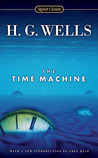
"The Time Machine" by H.G. Wells

The Time MachineThe Time Machine by H.G. Wells
My rating: 3 of 5 stars

It’s incredible how *not* dated it is. I was surprised to hear a discussion of time-space equivalency, how time is just another dimension in physics, 10 years before Einstein’s theory of relativity! (it was my belief that “spacetime” was popularized only after Einstein’s physics revolution, but now I know better). I was equally surprised by his use of evolution in all of its nuances as such a fundamental part of the plot.

Of course, he doesn’t get it right: evolution works way too fast on his story, and a few things aren’t quite right regarding how stars work, among other things. But the biggest problem are his ideas of how society and people work. A lot of the story revolves around the premise that the higher classes are better, in general, than the working poor - not just better in terms of how well they are doing, or how schooled, prepared, etc… Actually better, in some innate sense, such that the poor could never rise above their stations because they lack something. That the poor do the hard work because they are better suited for it, they even like it, they are happy to do the hard labor. Wells devotes a lot of pages to describing his ideas of society, and speculations on how it will evolve in the future. Maybe it’s part of an elitism inherent to 19th century England, but it was irksome. At the end, though, the dynamics between the Eloi and the Morlocks might be pointing that exploitation of the workers will lead to disaster, and some social justice is served.

Despite the long, sometimes repetitive and boring monologues, it was not a bad read.


View all my reviews

Monday, March 16, 2015

The Quantum Thief - Terrible physics, great sci-fi

The Quantum Thief (Jean le Flambeur, #1)The Quantum Thief by Hannu Rajaniemi
My rating: 4 of 5 stars

Terrible physics, great sci-fi.

Initially, my inclination was to hate the book. My main problem is the self-importance that seems to exude from the book and the protagonist: the protagonist is “the one”, the cleverest, most intelligent, most charming, most handsome, bravest, etc…, rogue in the universe. It’s annoying because it’s a mix of the usual tropes of the Gentleman Thief and the Lovable Rogue, a bit like Robin Hood. The best parallel is almost every thief in RPG games and books, but this time in a pseudo-sci-fi setting. I call it pseudo sic-fi because it feels more like a fantasy setting, with warriors and wizards, using some physics-sounding names so that it’s not obvious that all this stuff is pure magic. This gets pretty annoying, because a lot of the stuff sounds like it should made sense, but it really doesn’t. For example, the author throws around the word “quantum” without any care for what it means, like when he mentions that there is a "quantum link” between two characters; it seems that you can safely replace “psychic” for “quantum” anywhere in book! And the use of the latest jargon does very little to mask what are obvious crappy sci-fi staples, like “nano-missiles” (“photon-thorpedoes”?), WIMP beacons, neutrino scanners, etc...

If you stop thinking of this less as sic-fi and more as fantasy, it gets less annoying; magic is magic, it doesn’t have to make sense. Once you get through that, you can see how great the book is. The story itself is not necessarily great - I am not sure I cared much for the plot, and certainly didn’t care for the main protagonist, the Thief (although I liked a lot the secondary protagonist, the Detective). However, the book presents an incredibly rich world, with new concepts that deconstruct and break all traditional sense of society and self.

Although terrible on physics, the book excels when it comes to things taking place in the realm of the mind: communication, augmentation, consciousness, resurrection, and tons of other features that go completely unexplained. There is a meshing of the physical and virtual world, like the Magic Leap augmented reality concept, but it seems to include not only vision and the other physical senses, but also memory and consciousness. It seems that it’s on all the time, and people can use virtual screens to hide or to keep private - and other people are obliged to comply with these virtual screens. People brains have been digitized, and their bodies (and brains) seem to be artificial. It all makes very little sense, but that’s ok; here the author is pushing the envelope, developing new ideas, and I think we can forgive him if he doesn’t know how something would work; the point is not the how, but what happens next, how things could be. Here he is creating something new and just beyond our understanding, offering us glimpses not only of the future, but of a fantastic new reality where things work very different from ours (like cavemen would see the our world). It is a truly revolutionary and evolutionary look into humanity’s possible future, and the highest caliber sci-fi.

View all my reviews

Thief of Time

Thief of Time (Discworld, #26; Death, #5)Thief of Time by Terry Pratchett
My rating: 4 of 5 stars

Thief of Time tells the story of the construction of the world's most accurate clock, and how that will bring about the end of the world! Like the previous Discworld books, this is a fantasy novel in a medieval-like and magical setting, but this time it mixes in some science fiction to the story. It liberally uses concepts from relativity and quantum physics, and although it's only very superficial (and "stretched" to fit the Discworld style), it still makes good sci-fi. In fact, and very surprisingly, it's one of the best "sci-fi" books I have read recently!

Also, it's a very entertaining book. On my last review of a Discworld novel (I am going through the whole series), I complained about Terry Pratchett losing his initial spark, getting a little repetitive, and how that was understandable, after more than 20 books... Well, turns out he still has that spark, and can still write brilliant stories in the Discworld!


View all my reviews

Good reads

I haven't posted here forever, so now I am resurrect this blog with a new purpose.  Previously, I used it to document my travels, but that ended up being too much work.  To keep it alive until I start having new comment, I will post my book reviews from Goodreads.  Not great stuff, but it's the only non-physics stuff I have been writing lately, so here it goes.

Saturday, November 02, 2013

Fiat LUX

Publicamos nossos primeiros resultados! A minha experiência, LUX Dark Matter Search, anunciou esta semana os resultados do "run" inicial de ~90 dias. Este é um "run" curto, com o objectivo de demonstrar que o detector funciona bem, e não viu nenhum sinal de matéria escura. No entanto, acabou batendo a sensitividade de todos os outros experimentos, demonstrando que os possíveis sinais positivos nos outros experimentos são falsos, e é agora o melhor detector de matéria escura do mundo! Agora podemos começar a experiência pra valer, que vai durar mais 300 dias de aquisição de dados, talvez com uma descoberta no fim ;)
Aqui estão alguns artigos, explicando tudo em português:

Wednesday, September 04, 2013

SUSY2013, Trieste e Veneza

Semana passada fui dar uma palestra na conferência sobre Supersimetria SUSY 2013, em Trieste, na Itália.  Foi uma palestra simple, um "status update" sobre a experiência LUX, nenhum resultado novo pra mostrar.  E também parecia que o pessoal fazendo SUSY (quer dizer, os teóricos) estão um pouco perdidos, sem nenhuma idéia nova, a espera do futuro "run" do LHC para terem novos resultados.  Acho que a figura do Dimopoulos explica bem a posição dos teóricos:


Ainda sim foi legal, deu pra discutir bastante sobre as consequências dos últimos resultados do LHC para matéria escura, e a conferência estava cheia de brasileiros, o que fez tudo mais divertido :)

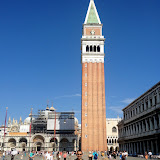
Depois ainda deu pra passa 24 horas em Veneza na volta.  A cidade é espetacular, lindíssima.  Só é pena que estava sozinho.  Definitivamente, vou ter que voltar ;)

Fotos de Trieste Fotos de Veneza

Sunday, June 02, 2013

Chegada em Portugal

 Esta semana cheguei em Portugal depois de quase 4 meses nos Estados Unidos, e milagrosamente não perderam nenhuma das minhas malas!  Mas isso era só uma breve calma antes da tempestade - eu mal sabia o que me esperava em casa...

Quando chego em casa na terça, descubro que cortaram a eletricidade.  Não parece tão mal, exceto... A geladeira!  Eu tinha deixado umas carnes e legumes congelados, mas agora era só uma massa cinzenta uniforme, gotejante, e um cheiro de putrefação horrível.  Descubro também que cortaram meu celular, e portanto não tenho internet nem outro meio de comunicação, então vou andando pra EDP.  O problema afinal é que apesar de eu ter debito direto da conta, logo no primeiro mês a conta ficou acima do limite e o dinheiro não foi debitado, e apesar de eu receber todas as minhas contas por email, os avisos de atraso só vem por carta.  Eles vão reativar a conta, mas só podem ir ligar a luz na quinta-feira!  Até lá, velas, geladeira trancada pro cheiro não escapar, sem internet, e banho gelado - e ainda por cima a fazer frio!

Logo depois fui a vodafone pra reativar o celular, mas ele só volta a receber sinal na manhã seguinte.  Resultado: ele fica sem bateria, porque passou a noite toda tentando reconectar.  Eu decido ir a universidade carregar o celular e laptop, mas começa a maior chuva.  Não tem problema, basta ir de carro... exceto que a bateria estava descarregada e o carro não pega!  Eu passo o dia em casa, desfazendo as malas e arrumando a casa.

Na quinta de manha, finalmente ligam a eletricidade, e eu faço uma limpeza geral na geladeira.  O seguro cobre mandar um mecânico pra dar a partida no carro.  Parece que está tudo se resolvendo, mas aí eu descubro que o roteador morreu, e eu fico sem internet em casa.  Também descubro cortaram minha conta do Via Verde (o pedágio automático de Portugal), porque eu mudei de cartão de crédito e não os avisei.  E agora que já tenho eletricidade pro aquecedor a água quente, a chuva para e o clima esquenta.  E quando entro em casa no fim do dia vejo que o cheiro ainda está lá - deixo a geladeira "de molho" em vinagre, pra ver se passa.

Sexta-feira de manhã a casa toda cheira a vinagre, e lá vou eu passar mais 2 horas limpando a geladeira (e todos os buracos, frestas, borrachas, etc...).  Parece que o cheiro finalmente está passando. Arranjo outro roteador, troco os cartões na Via Verde.  Agora sim, tudo está se resolvendo.  E assim que eu começo a relaxar, caminhando da universidade pra casa no fim-do-dia, ploft!  Um pássaro faz cocô na minha cabeça.

Assim é perseguição!


Tuesday, February 12, 2013

Underground toilets

Working 1.5km (~1 mile) underground presents a unique set of challenges.  Among them: how do go to the bathroom?  There is very limited water plumbing, so the use of standard toilets is not possible.  The solution: incinerating toilets!  Just make sure you aren't seating on it when it's active.


Friday, February 08, 2013

Train Joy Ride

Training to be a guide in the Sanford underground laboratory.
Cons: you are more likely to work nights and weekends;
Pros: you get to drive the train!